0:00
0:00
The long-standing consensus around US equity leadership is being tested, as shifting global dynamics herald the start of a new investment cycle. For more than a decade, investors have relied on US assets as the anchor of global portfolios, justified by technology dominance, deep capital markets, and institutional stability. That consensus is now being re-examined in light of evolving market conditions. In the latest research from Ninety One’s Investment Institute, The great rebalancing: A new cycle reshaping global equity leadership, Analyst Dan Morgan argues, that “if the age of the unquestioned American overweight is behind us, the implications will be profound.”
Beyond the one-way trade
Since the global financial crisis, US equities have consistently outperformed developed and emerging market peers, supported by a remarkably persistent dollar cycle. Fifteen years of outperformance reshaped global allocation patterns and attracted record foreign capital. By the end of 2024, international investors had accumulated US assets worth $62 trillion — more than double the size of the US economy.
Dan Morgan, Analyst: “US equities have outperformed both developed and emerging market peers for over a decade, shaping today’s portfolio allocation patterns. The US dollar has also been exceptionally strong for many years, and there is a remarkable historical overlap between these long dollar cycles and the relative performance of US versus international equities.”
US outperformance has been increasingly driven by a small number of mega cap companies. As of June 2025, the largest 10% of US listed companies had an average market cap of $240 billion, compared to $4.4 billion for the median US company, making the largest companies 55x more valuable than the average company – the highest this ratio has been in 100 years. Markets may be approaching an important turning point. “Current conditions, valuation extremes, divergent policy trajectories, and recent shifts in capital flows suggest markets may be at a critical inflection point,” said Morgan.
Periods of intense concentration have typically led to weaker 10-year returns
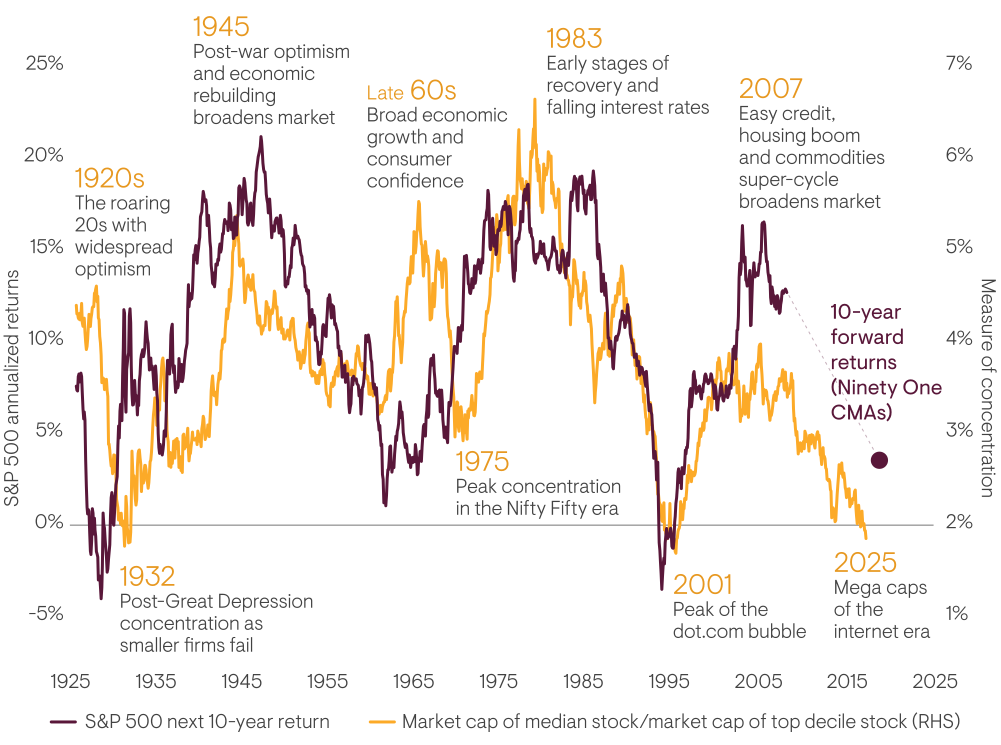
Source: Ninety One, Bloomberg, July 2022.
A broader cycle of leadership
At the same time, international markets are gaining momentum. Europe’s relaxation of fiscal rules, Japan’s corporate resurgence, and Asia’s rise in advanced manufacturing and AI innovation all point toward new sources of leadership. China, for example, has built the world’s largest and most efficient manufacturing sector, with facilities producing one battery cell every second and operating at 95% automation1. Morgan said: “the next cycle could broaden equity market leadership significantly, driven by AI innovation and a weaker dollar, creating opportunities across sectors and regions.”
Unlike the internet, where winner-takes-all dynamics saw value concentrated in a handful of US platforms, AI holds the potential for productivity gains which are broadly spread across industries and geographies.
Implications for portfolios
Today, US equities make up nearly 70% of global benchmarks, despite representing only 40–50% of fundamental measures such as revenues, earnings, and cash flows. This disconnect highlights the limitations of relying solely on market-cap benchmarks for diversification.
“Fundamental indicators suggest a lower allocation to US equities than implied by market-cap benchmarks, with international and emerging markets offering potentially stronger returns.”
Ninety One’s ten-year projections suggest US equities will deliver annualised returns of 3.7%, compared to 6.3% for developed ex-US equities and 7.2% for emerging markets2.
Morgan concludes: “Regional performance cycles have remarkable staying power, but once clear evidence emerges that a cycle is shifting, investors can reposition portfolios for sustained new trends. Market-cap-weighted benchmarks anchor portfolios in the past, reflecting yesterday’s winners rather than tomorrow’s opportunities.”
1. CATL’s Ningde (Fuding) facility spans about 1.5 million m² (~16 million ft², ~278 football fields) [EnergyTrend]. It produces one lithium-ion cell per second [InsideEVs], operates at around 95% automation [PR Newswire], and according to industry reports, uses around 1,000 robots on its lines [World Economic Forum, Global Lighthouse Network].
2. Ninety One as of 31 December 2024.