Key takeaways
- A global capital expenditure supercycle — driven by the energy transition, geopolitical fragmentation, re-shoring and AI infrastructure — is repricing equity markets in favour of companies with physical assets and specialised manufacturing capabilities.
- We see two types of beneficiary in the decarbonisation investment universe: equipment providers that supply the picks and shovels of the capex cycle, and owners of scarce physical assets with durable, hard-to-replicate competitive advantages.
- AI’s disruption of capital-light business models is providing an additional near-term driver of these stocks, as markets reassess the persistence of competitive advantages across equity markets.
- We believe the market continues to misprice the earnings trajectory and competitive advantages of many companies in the Global Environment portfolio1.
The HALO trade in context
Over the past year, investors have grown wary of software and other capital-light businesses seen as at risk of AI disruption. Instead, they have shown renewed interest in businesses grounded in physical infrastructure and networks, and manufacturing. This shift, now widely labelled the HALO (heavy-asset, low obsolescence) trade, upended equity market leadership in Q1 2026.
The HALO trade should be seen as more than a temporary shift in sentiment. The wider context is that long-term tailwinds for companies with in-demand physical assets, like many of those in the decarbonisation investment universe, are gathering strength.
A capex supercycle is repricing physical assets
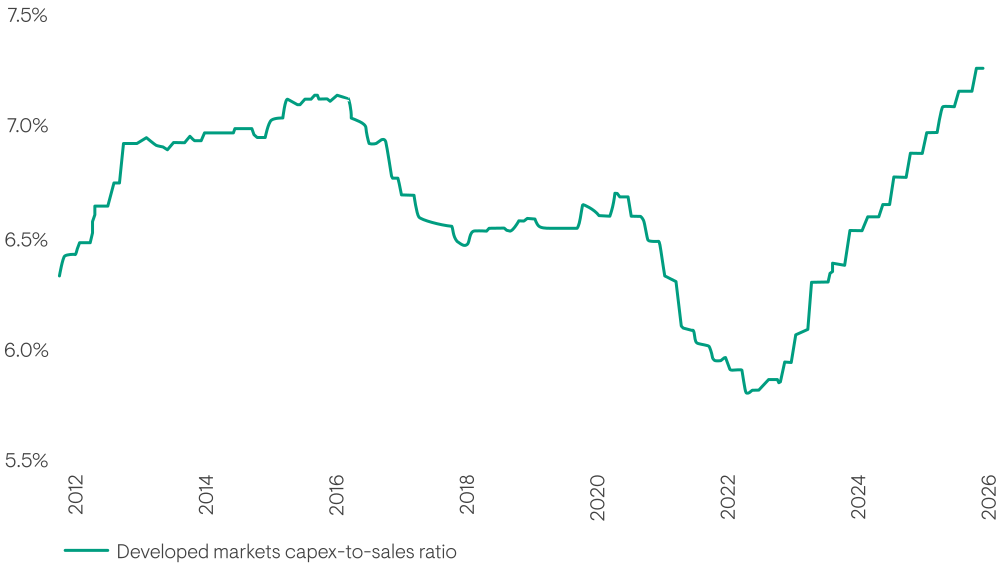
Two years ago, we argued that the global economy was on the verge of a capital expenditure (capex) supercycle – a structural shift that would see global gross fixed capital formation (a measure of the net increase in investments by public and private sectors) rise 12-24% above trend by 2030, representing an additional US$2.5-5 trillion per year of physical investment2. The drivers are multiple and reinforcing: the energy transition (the largest single component, accounting for an estimated 9-18% of additional global capex), AI and data-centre infrastructure, defence spending, re-shoring (repatriating formerly outsourced production), and the replacement of ageing infrastructure in both developed and emerging economies. The US AI hyperscalers alone are set to deploy approximately US$650 billion in capital expenditure in 2026. The spending trend is already showing through in the data, with capex-to-sales ratio recently reaching a decade high, reversing years of under-investment (Figure 1). The primary beneficiaries of this spending are businesses with physical assets.
Figure 1: Capital expenditure is rising steeply
Source: Datastream, FactSet, Goldman Sachs Global Investment Research.
Events since then have strengthened the ‘capex supercycle’ thesis. The end of ‘easy globalisation’ means the post-Cold War model of international integration built on cheap energy, unipolar geopolitics and political consensus is no longer stable3. Conflict in the Middle East and Ukraine have reinforced the imperatives of energy security and supply-chain resilience, both of which demand physical investment.
Capex cycles matter because they can have a significant impact on asset returns. As we argued back in 2024, a new capex supercycle:
“…will result in very different market leadership to the last cycle, which is not well understood by all market participants. Stock beneficiaries are not restricted to the US but are spread across geographies and are primarily in physical asset-intensive areas of industrials, resources and utilities, sectors that lagged or tracked the market in the post- Global Financial Crisis period4”.
This environment favours two types of company in the decarbonisation investment universe.
1 Equipment providers: the picks and shovels of the capex cycle5
Companies that supply the mission-critical equipment underpinning the capex supercycle are growing rapidly. As capex accelerates across energy infrastructure, AI data centres, grid modernisation and advanced manufacturing, these businesses are direct beneficiaries of the spending. These companies share a distinctive set of competitive characteristics:
- Niche, differentiated products and services. They provide specialised equipment that cannot easily be substituted by a competitor’s offering.
- Low cost to the customer, but critical. Their products are typically a small percentage of the customer’s total project cost but essential to its operation. Customers are willing to pay for performance rather than shopping on price.
- Opportunity to drive efficiency, including decarbonisation. The equipment provided often improves energy efficiency or enables cleaner processes, reinforcing demand.
- Pricing power from performance. High-performance, mission-critical equipment that drives customer efficiency can command premium pricing and sustain it through cycles.
WEG is a good example. The company is the world’s largest industrial motor manufacturer and a leading producer of power transformers — the devices that step voltage up or down at every node of the grid, essential to connecting any new power source or demand centre to the network. Global transformer supply has been constrained by decades of underinvestment, while demand from data centres, renewable interconnections and industrial re-shoring has surged. WEG’s order book extends into 2028-29, and it has plans to roughly double transformer production capacity by 2026. Vertical integration and automation have historically delivered margins well above those of WEG’s larger European peers.
Another example is Hongfa, the world’s largest relay manufacturer with approximately 23% global market share. The company holds about 40% share in the fast-growing market for high-voltage direct current (HVDC) relays. Relays are electrically operated switches that safely open and close high-voltage circuits in every electric-vehicle battery pack, solar inverter and energy storage system. They account for a small fraction of the end-product’s cost but are essential for electrification. Four decades of product focus, vertical integration and automation have underpinned stable gross margins of near 38% and consistent returns on equity of 15-20% through the cycle.
2 Scarce physical assets: the market has begun to reprice obsolescence risk6
Secondly, we believe the capex cycle and current market environment benefit companies whose competitive advantages derive from ownership of scarce physical assets: infrastructure, networks and production capacity built over decades that cannot realistically be replicated.
Markets are increasingly attuned to this characteristic. AI is disrupting many capital-light business models that dominated equity leadership in the past decade, as it lowers the cost of information processing and compresses differentiation. The sharp derating of software stocks in recent months reflects not a collapse in near-term earnings but a repricing of terminal value and margin durability. For much of the last decade, software businesses with high recurring revenues were considered the gold standard of competitive-moat durability. We believe the market is now placing greater value on durable, scarce and hard-to-replicate physical assets that are less disruptable and therefore warrant higher moat windows relative to software- and service-oriented companies.
Companies that own scarce physical assets have high barriers to entry, often built over decades and sometimes protected by regulatory frameworks. Their scarcity creates pricing power that is less vulnerable to competitive erosion. And we believe many of these moats are widening: as the capex supercycle demands more physical capacity – more grid infrastructure, more transport networks, more battery manufacturing – the scarcity value of existing large-scale assets increases further.
NextEra Energy exemplifies this. Surging electricity demand from data centres, industrial re-shoring and electrification is driving an estimated 450 GW of additional power need in the US, far outpacing the speed at which new supply can be built. NextEra Energy is the world’s largest operator and developer of wind and solar power, with over 34 GW of renewable capacity. After decades of investment, it has secured the most productive wind and solar sites in the country, positions that cannot be replicated by later entrants, alongside the largest regulated electricity network in the US through its Florida utility. That combination of scale, site quality and regulated infrastructure makes NextEra Energy the most attractive beneficiary of America’s power build-out, in our view.
CATL, the world’s largest battery manufacturer with 676 GWh of installed production capacity, illustrates the same point from the manufacturing side. Barriers arise from scale, cost, engineering complexity and time-to-build — reinforced by US$2.6 billion of research and development spending in 2024 alone, more than all major Korean battery producers combined. CATL shipped 339 GWh of electric-vehicle batteries in 2024, equivalent to supplying 6.5 million vehicles, and accounts for approximately 40% of the fast-growing global energy storage market7.
Investment implications
The companies in the Global Environment portfolio are forecast to deliver 18% earnings-per-share growth on average over the next year8, compared with approximately 14% for a group of capital-intensive companies broadly (as calculated by Goldman Sachs) and 10% for a group of capital-light companies9. This superior earnings trajectory reflects the structural growth impact from the capex supercycle, and the AI disruption risk across software and services.
However, the historical valuation premium that investors have been willing to pay for this superior growth has largely disappeared in recent years. This does not reflect a decline in portfolio quality – since inception the strategy has delivered an average return on equity of approximately 16% versus approximately 15% for the MSCI ACWI – but rather a deterioration in sentiment towards clean-technology sectors generally. We view this as a mispricing.
As the capex supercycle intensifies, we believe selectively allocating to mispriced leaders within the decarbonisation value chain offers a way to gain exposure to capex-driven structural growth, while also building a portfolio with the potential to generate a distinctive return profile versus global equities. By focusing on companies with competitive advantages rooted in the physical world, whether as equipment providers or owners of scarce assets, such a portfolio should carry low risk of technological obsolescence and high exposure to the durable tailwinds shaping the next decade.
The HALO trade should therefore be understood not as a short-term market rotation, but as a signal of where value should be expected to accrue in equity markets as a capex supercycle plays out alongside disruptive AI. We believe the decarbonisation investment universe is among its primary beneficiaries.
Global Environment portfolio,
as at 31 March 2026
The following tables show the composition of the Global Environment portfolio as at end-March 2026, divided between the two types of HALO stocks discussed above: equipment providers and companies with scarce physical assets. The weighting and 12-month total effect contribution (or detraction) from relative returns is shown for each holding.
Equipment providers
Niche, differentiated manufacturers supplying mission-critical equipment to the capex supercycle. Revenue model is product sales; moat is IP and manufacturing specialisation, not ownership of deployed assets.
| Name | Weight | Total effect |
|---|---|---|
| Infineon Technologies | 5.9% | 0.5% |
| Schneider Electric | 4.5% | -0.1% |
| TE Connectivity | 4.0% | 1.4% |
| Atlas Copco | 3.6% | -0.1% |
| Valmont Industries | 3.4% | 0.0% |
| Spirax Group | 3.0% | -0.2% |
| Sungrow Power Supply | 2.4% | 0.2% |
| Hongfa Technology | 2.4% | 0.2% |
| Shimadzu | 2.2% | -0.7% |
| WEG | 2.0% | 0.9% |
| Trane Technologies | 1.8% | 0.3% |
| Xiamen Faratronic | 1.7% | 0.0% |
| Voltronic Power | 1.6% | -2.1% |
| Vestas Wind Systems | 1.5% | 1.9% |
| Silergy | 1.3% | 0.0% |
| SCREEN Holdings | 1.1% | 0.0% |
Scarce physical assets
Companies whose competitive advantage derives from ownership of infrastructure, networks or production capacity built over decades that cannot realistically be replicated. Revenue flows from operating, not selling, those assets.
| Name | Weight | Total effect |
|---|---|---|
| Taiwan Semiconductor Manufacturing Co. | 7.4% | 3.2% |
| NextEra Energy | 6.0% | 0.9% |
| Contemporary Amperex Technology Co. | 5.3% | 2.3% |
| Iberdrola | 4.4% | 1.8% |
| Canadian Pacific Kansas City | 4.2% | -0.6% |
| Waste Management | 2.5% | -0.6% |
| Power Grid Corp of India | 1.2% | 0.0% |
Attribution analysis (shown in USD) shows how the portfolio management contributed to (or detracted from) the resulting relative performance. Based on a related portfolio with substantially similar objectives as those of the services being offered. Shown gross of fees and expenses.
Please refer to the presentation of the total portfolio or composite gross and net performance to understand the overall effect of fees.
Relative Index: MSCI All Country World Index.
For further information on indices and specific portfolio names, please see the Important Information section.
Strategy composite performance (USD)
| 1 year | 5 years p.a. | Since inception p.a. | |
|---|---|---|---|
| Strategy (gross) | 21.1% | 3.0% | 11.2% |
| Strategy (net) | 20.4% | 2.4% | 10.5% |
| Benchmark | 20.0% | 9.5% | 10.4% |
Past performance does not predict future returns; losses may be made.
Source: Ninety One, March 31, 2026. Where performance is gross of fees, returns will be reduced by management fees and other expenses. Net performance is net of the highest institutional segregated portfolio management fee. For more information, see the GIPS disclosures. Both gross and net returns are in USD, shown net of all trading expenses. Income is reinvested, in USD. Performance start: 01 September 2018. Strategy: Global Environment. Benchmark: MSCI AC World Index NDR. Indices are shown for illustrative purposes only.
General risks. The value of investments, and any income generated from them, can fall as well as rise. Costs and charges will reduce the current and future value of investments. Where charges are taken from capital, this may constrain future growth. Past performance does not predict future returns. If any currency differs from the investor’s home currency, returns may increase or decrease as a result of currency fluctuations. Investment objectives may not necessarily be achieved; losses may be made. Target returns are hypothetical returns and do not represent actual performance. Actual returns may differ significantly. Environmental, social or governance related risk events or factors, if they occur, could cause a negative impact on the value of investments.
Specific risks. Currency exchange: Changes in the relative values of different currencies may adversely affect the value of investments and any related income. Derivatives: The use of derivatives is not intended to increase the overall level of risk. However, the use of derivatives may still lead to large changes in value and includes the potential for large financial loss. A counterparty to a derivative transaction may fail to meet its obligations which may also lead to a financial loss. Equity investment: The value of equities (e.g. shares) and equity-related investments may vary according to company profits and future prospects as well as more general market factors. In the event of a company default (e.g. insolvency), the owners of their equity rank last in terms of any financial payment from that company. Concentrated portfolio: The portfolio invests in a relatively small number of individual holdings. This may mean wider fluctuations in value than more broadly invested portfolios. Emerging market (inc. China): These markets carry a higher risk of financial loss than more developed markets as they may have less developed legal, political, economic or other systems. Sustainable Strategies: Sustainable, impact or other sustainability-focused portfolios consider specific factors related to their strategies in assessing and selecting investments. As a result, they will exclude certain industries and companies that do not meet their criteria. This may result in their portfolios being substantially different from broader benchmarks or investment universes, which could in turn result in relative investment performance deviating significantly from the performance of the broader market.
1 For further information investment process and specific portfolio names, please see the Important information section. The portfolio may change significantly over a short space of time.
2 Ninety One Investment Institute, A new capex supercycle: driving powerful and transformative growth, April 2024.
3 Ninety One Investment Institute, The end of easy globalisation, April 2026.
4 Ninety One Investment Institute, A new capex supercycle: driving powerful and transformative growth, April 2024.
5 Securities selected as examples of holdings with ‘HALO’ characteristics in the view of the investment team.
6 ibid.
7 Company reports and Ninety One research.
8 Ninety One, as at March 2026. Inception date: 1 September 2018. Calculations for ROE use MSCI aggregation methodology for both the portfolio and benchmark. The portfolio may change significantly over a short space of time.
9 Goldman Sachs, Strategy Matters: The HALO effect, February 2026.
