Key takeaways
- Shifts in the behaviour of traditional asset classes are forcing asset allocators to rethink how they build portfolios. Emerging market (EM) debt’s powerful diversification properties have increased its appeal and relevance.
- From multiple perspectives, this diverse and flexible asset class has strengthened and matured, reflecting credible economic policymaking and strong corporate governance.
- For investors seeking a truly diversified allocation, a standalone allocation is key, while investing across all areas of EM debt in a ‘blended’ portfolio can help balance different return drivers through the cycle.
- History has shown EM debt to provide a return premium over developed markets which has comfortably exceeded the relative risk. It also offers ample liquidity, providing a compelling alternative to the maturing developed private credit market.
- Even in 2025 – a strong year for the asset class – wide disparities between top and bottom performing market returns highlighted the diversity of EM debt. An active investment approach is vital.
Answering today’s challenges
Last year marked a turning point for emerging market (EM) debt. Inflows into this often overlooked but significant segment of the global fixed income market signalled a shift in perceptions. A key driver of this shift is that EM debt’s powerful portfolio diversification benefits make it highly relevant to asset allocators at a time when fixed income markets have entered a new regime, with US Treasuries and other leading global bond markets now in a more volatile era.
In recent years we have seen a series of ‘supply shocks’ – including COVID-19, Russia’s invasion of Ukraine, and trade tariffs. Unlike demand shocks, these are exceptionally hard to quantify and have resulted in growth and inflation moving in opposite directions – i.e., lower growth and sticky inflation. That has driven up correlations between defensive and cyclical assets, meaning developed market bonds have been less able to shield investors from equity market losses.
All of this has put traditional asset allocation approaches under the spotlight while making effective portfolio diversification a priority for many investors.
That said, the increased allure of EM debt extends beyond its diversification power – ongoing credit-rating upgrades and credible policymaking have provided clear evidence of maturity in EM economies.
Why make a dedicated allocation?
For investors seeking a truly diversified allocation to EM debt, a standalone allocation may be the most effective way of achieving it. While global fixed income allocations offer some EM exposure, it is relatively small, heavily skewed to China/Asia, and underweight EM corporate debt.
Similarly, multi-sector credit strategies may not provide EM exposure that is sized and diversified in a way that matches investors’ objectives and risk budget. Approximately half of multi-sector credit funds in the eVestment universe are constructed in a benchmark-agnostic fashion and only 9% of the remainder have a benchmark allocation to EM debt. Even among those managers that do allocate to EM debt, the average allocation is under 10%. As multi-sector credit is typically a subset of an investor’s overall fixed income allocation, it follows that total exposure to EM debt is typically extremely low among investors who access the asset class this way.
These are important considerations for investors looking to align their strategic asset allocation with global macroeconomic and investment trends. Longer-term global economic momentum is shifting away from developed markets, with emerging markets constituting a larger share of economic activity. Finally, EM debt allocations within multi-sector credit portfolios typically only focus on hard currency sovereign and corporate debt, thus ignoring the much larger EM local currency debt opportunity.
One asset class, multiple markets and drivers
| Hard currency sovereign debt | Hard currency corporate debt | Local currency sovereign debt | |
|---|---|---|---|
| Definition | Debt issued by EM governments and companies that are 100% state-owned. Denominated in US dollars (or, e.g., euros). | Debt issued by companies based in EM economies, usually denominated in US dollars. | Debt issued by EM governments that is denominated in the domestic currency of the issuer. |
| Index* | JPMorgan EMBI Global Diversified | JPMorgan CEMBI Broad Diversified | JPMorgan GBI-EM Global Diversified |
| Number of countries | 68 | 67 | 19 |
| Total debt stock (US$bn) | 1,832 | 2,623 | 15,646 |
| Average credit rating | BB+ | BBB- | BBB |
Source: Ninety One, JPMorgan EMBI Monitor, as of 28 February 2026.
*The indices shown are those that are most commonly adopted as a primary benchmark by investment managers.
A powerful portfolio diversifier
EM debt is a diverse asset class spanning different currencies, issuer types and credit ratings, with at least 80 countries accessible to investors, as well as around 700 corporate issuers. This diversity makes the asset class a highly flexible building block for investment portfolios.
Considering the three key components of the asset class and their drivers, EM debt can provide diversification in a variety of ways – from local currency markets giving exposure to different yield sources, to dollar-denominated markets providing an attractive alternative growth fixed-income allocation that offers a yield pickup for similar credit quality to developed market debt.
| EM debt component | Drivers |
|---|---|
| Local Currency Bonds (FX hedged) | Rate market moves: inflation, monetary policy, fiscal policy |
| EM FX | Balance of payments, growth, monetary policy, interest rate differentials |
| Hard Currency Bonds | Credit spread moves: growth, external balances, balance of payments, fiscal policy |
Source: Ninety One.
In addition to its low correlation to other asset classes, investors can benefit from significant diversifying forces within this asset class:
- The behaviour of local currency debt markets reflects differing interest rate regimes, divergent economic cycles and currency fluctuations. Countries within this market behave quite distinctively and broadly fall into one of three cohorts: high-quality Asia, Central and Eastern Europe, and more cyclical markets.
- The hard currency debt market spans oil exporters and importers, regional manufacturing hubs and services-driven economies. The increased importance of smaller ‘frontier’ markets further expands the range of underlying return drivers.
- Similarly, today’s EM corporate credit universe is truly global – and home to companies that control global market brands such as Samsung, Volvo and GE Appliances. China accounts for just 6% of the flagship index now, highlighting that the asset class is not beholden to any single market. From protein producers in Latin America, to tech leaders in Asia, which is emerging as the global AI factory, the opportunity set is richly diverse.
A key benefit to investing across all EM debt asset classes is that the performance of each sub asset class is differentiated through the broader economic and monetary policy cycle. In other words, a ‘blended’ allocation that provides access to multiple asset classes in a single portfolio may help balance different return drivers through the cycle.
Supported by resilient fundamentals as EM economies mature
While emerging markets are certainly not risk-free, the difference between EM and developed market (DM) assets is typically overestimated. But recent developments are putting old perceptions to the test: EM economies’ credible monetary and fiscal policy are driving positive credit-rating momentum at a time when policymaking in DM economies has become less predictable – as reflected in unprecedented DM yield curve moves seen in the past few years.
In fact, under the radar, emerging markets have been coming of age over the past decade or more.1 Today, the asset class is underpinned by robust governance dynamics. In addition to fiscal prudence in many EM economies, monetary policy has also been disciplined and highly credible. Drawing on lessons from past inflation cycles, EM policymakers were among the first to respond to rising prices post-COVID-19 – a pattern that helped rein in inflation, stabilise real yields, and support local currency assets.
In short, EM economies appear increasingly robust across a variety of metrics, as shown below.
Prudent policymaking is paying off in EM economies
| Economics (2025 forecast) | Republic of DM | Republic of EM | |
|---|---|---|---|
| Number of countries in benchmark | 13 | 19 | |
| GDP (bn $) | 58,193 | 35,646 | → EM GDP is 40% higher |
| GDP (bn $, PPP based) | 67,029 | 85,273 | → EM PPP GDP is 27% lower |
| Debt (bn $) | 69,529 | 28,837 | → EM debt is 60% lower |
| Debt / GDP | 119.5% | 80.9% | → EM debt/GDP is 40% lower |
| Real GDP growth | 1.8% | 4.2% | → EM growth is twice as high |
| Current account | -0.6% | 0.3% | → EM runs a current account surplus |
| Benchmark yield | 3.8% | 5.9% | → EM bond yields are 200bps higher |
Source: Yields as at 31 December 2025. DM covers 13 Developed Markets in the JPMorgan GBI Benchmark. EM covers 19 Emerging Markets in the JPMorgan GBI-EM. Where applicable, data is weighted by GDP. IMF October 2024 WEO, JPMorgan benchmarks, Ninety One calculations.
Offering a structural premium and liquidity
Considering the long-term investment outcomes of the EM debt asset class, history has shown it to provide a return premium over developed markets which has comfortably exceeded the relative risk.
| Returns and volatility in USD | Returns and volatility in EUR | |||||||
|---|---|---|---|---|---|---|---|---|
| 5yr total return | 5yr vol | Yield | Yield/vol | 5yr total return | 5yr vol | Yield | Yield/vol | |
| Developed Market | -17.3% | 7.8% | 3.7% | 0.5 | -14.0% | 5.5% | 3.7% | 0.7 |
| EM Local Currency | 5.7% | 9.4% | 5.9% | 0.6 | 10.0% | 5.5% | 5.9% | 1.1 |
| EM Hard Currency | 9.2% | 9.0% | 7.3% | 0.8 | 13.6% | 7.8% | 7.3% | 1.1 |
| EM Corporate | 13.0% | 5.7% | 6.0% | 1.1 | 17.5% | 6.6% | 6.0% | 0.9 |
| EM Blend (50/25/25) | 8.6% | 8.0% | 6.4% | 0.8 | 13.0% | 5.7% | 6.4% | 1.1 |
Source: Please see Figure 1 below.
Furthermore, a blended portfolio that invests dynamically across each component of the asset class can enhance this favourable comparison even further.
Figure 1: Blending EM debt has improved investment outcomes
Five-year total return in USD, rebased to 100
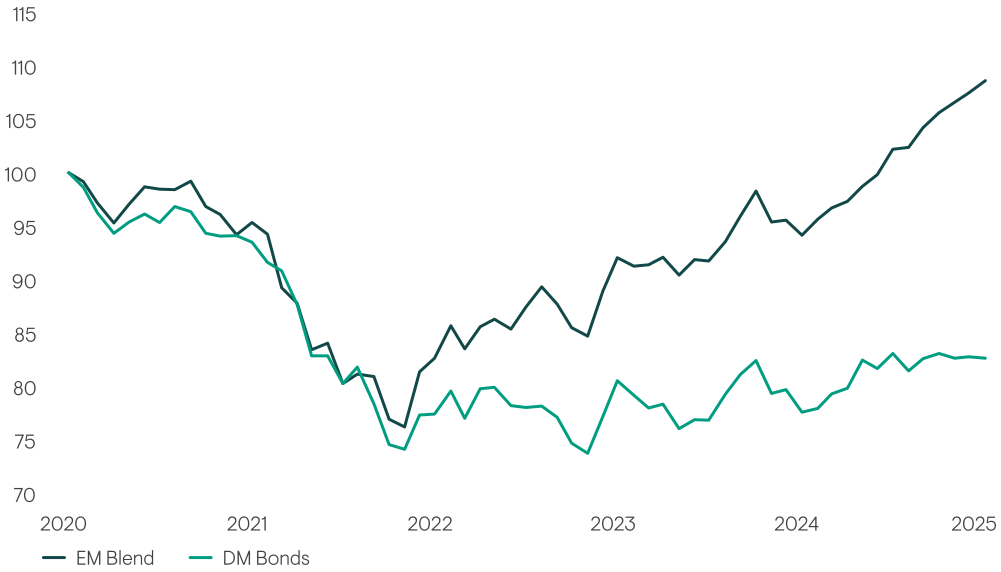
Source: JPMorgan indices, monthly, 31 December 2020-31 December 2025. DM is JPMorgan GBI, EM is JPMorgan GBI-EM GD (“Local Currency”), JPMorgan EMBI GD (“Hard Currency”), JPMorgan CEMBI BD (“Corporate”). For further information on indices, please see the important information section.
Why risk is persistently mispriced
Broadly, this enduring premium is explained by a combination of misperception around risk and a domestic bias among global investors. But there are other factors that mean the mispricing of risk persists. For instance, in the EM corporate debt market, credit spreads incorporate a significant ‘zip code premium’ – whereby country-specific concerns keep EM corporate spreads wider than DM peers despite robust underlying fundamentals. A notable example is Turkey’s banking sector: in many ways, this ‘looks’ like an investment-grade market but a challenging macroeconomic backdrop means that Turkish sovereign debt (and therefore corporate issuers) is in the high-yield category. Investors can earn relatively high yields on high-quality bonds here.
A liquid asset class
Beyond these long-term structural dynamics, a rising number of asset allocators today are concerned about illiquidity and risks in the maturing developed market private credit market. In this context, EM debt can offer a compelling alternative. In addition to the premium outlined above, public EM debt markets today offer investors ample liquidity. Contrast this with the US private credit market, where crowding has resulted in yield erosion and a loosening of underwriting standards – high-profile failures have signalled greater underlying risk than investors had previously assumed, and divesting is proving more challenging than expected.
Asset allocator case study
US OCIO targeting global high-yield returns through an EM debt toolkit:
- The ask: Replicate US high-yield risk-return profile but using EM credit.
- Performance objective: Low tracking error to US high yield but with higher quality and better return potential.
- Solution (proposed): 70% EM hard currency sovereign and corporate high yield, 30% EM sovereign and corporate investment grade with modest allowance for EM FX exposure.
Source: Ninety One. For illustrative purposes only.
Implementation: conviction and dynamism are key
Even in 2025 – a strong year for the asset class overall – wide disparities between top and bottom performing market returns highlighted that EM debt is not a homogenous asset class, with clear divergence between defensive and cyclical segments.
Increasing diversity across and within markets – spanning hard and local currency, and sovereign and corporate issuers – makes the one-size-fits-all ‘EM’ label look increasingly redundant, while underscoring the value of an active approach that dynamically blends different exposures. This is particularly true in the prevailing environment: the backdrop for the asset class is positive, but with differentiation in the outlooks of various countries - picking winners and avoiding losers is key.
Although research into the larger EM economies and companies has increased in recent years, many of the smaller frontier markets remain under-researched. This allows active investment managers to take advantage of market mispricing and a dislocation between valuations and fundamentals, increasing the potential for alpha capture. A high-conviction, active approach can add value when backed by a repeatable process and explicit risk controls. To assess whether risks are rewarded in this space, a comprehensive framework is vital, comprising qualitative (fundamental) and quantitative tools.
For investors that choose a blended allocation to the asset class, there are further important considerations. A blended strategy provides the opportunity for alpha capture through: 1. top-down allocation between local and hard currency debt; and 2. bottom-up selection of the best assets in each market. It should perform well when there is dispersion in the outlook across markets, which allows for relative-value positioning. While the ‘blended’ EM debt universe has grown significantly, it remains loosely defined. We believe that a blended EM debt portfolio should allocate dynamically between asset classes with a view to outperforming a mixed local currency/hard currency debt benchmark. We also believe that blended strategies should avoid taking excessive exposure to a single theme, country, currency, or economic outcome, and instead focus on finding high-conviction, bottom-up ideas.
In summary
EM debt is highly relevant for asset allocators today. In addition to powerful diversification benefits and distinctive characteristics, it offers an enduring risk-adjusted return premium. With shifts in behaviour among traditional asset classes forcing a rethink of asset allocation, and the EM debt asset class itself offering increasingly strong fundamental foundations, the investment case is robust. But a selective approach to investing is vital in this increasingly diverse asset class.
Why partner with Ninety One
Ninety One’s expertise lies in its deep emerging market heritage, integrated research structure, and genuinely active, innovation-led investment approach. With more than 30 years of dedicated experience in emerging markets, the team brings a depth of insight and intuitive understanding of local political, macroeconomic and market dynamics.
Having launched dedicated EM local currency debt portfolios as early as 2006, the team’s investment process was purpose-built for emerging markets rather than adapted from developed market frameworks. This approach has been tested and refined through multiple market cycles.
Our structured portfolio construction framework allows us to build strategies with defined parameters, risk guidelines, and benchmarks, delivering flexibility without compromising on rigour. We partner with global institutions seeking bespoke EM debt solutions aligned to policy objectives and governance constraints. The result is an EM allocation that is intentional, scalable and governable, designed to play a defined role in the total fixed income portfolio.
1 See Right place, right time: EM local currency debt today.
General risks. The value of investments, and any income generated from them, can fall as well as rise. Where charges are taken from capital, this may constrain future growth. Ongoing costs and charges will impact returns. Past performance does not predict future returns, losses may be made. If any currency differs from the investor's home currency, returns may increase or decrease as a result of currency fluctuations. Investment objectives and performance targets are subject to change and may not necessarily be achieved, losses may be made. Environmental, social or governance related risk events or factors, if they occur, could cause a negative impact on the value of investments.
Specific risks. Emerging market: These markets carry a higher risk of financial loss than more developed markets as they may have less developed legal, political, economic or other systems.
