The fast view
- Yield advantage: EM Debt provides a meaningful yield premium relative to US High Yield.
- Strong fundamentals: Fiscal discipline and proactive monetary policy are typical features of today’s EM Debt investment universe, providing solid macroeconomic foundations.
- A deep and diversified market: Over two decades, EM Debt has evolved into an $8+ trillion market – spanning oil exporters in the Gulf, technology leaders in Asia, and resource-rich economies in Latin America.
- Compelling entry point: EM Debt currently offers attractive valuations in terms of credit spreads and real yields, creating a compelling opportunity to enter the asset class.
- Portfolio construction benefits: EM Debt enhances portfolio diversification and can serve as a global complement to US credit exposure, without sacrificing returns.
Defining the EM Debt opportunity set
| Hard Currency Sovereign | Hard Currency Corporate | Local Currency Sovereign | |
|---|---|---|---|
| Definition | Debt issued by EM governments and companies that are 100% state-owned. Denominated in US dollars (or, e.g., euros). | Debt issued by companies based in EM economies, usually denominated in US dollars (or, e.g., euros). | Debt issued by EM governments that is denominated in the domestic currency of the issuer. |
| Index* | JP Morgan EMBI Global Diversified | JP Morgan CEMBI Broad Diversified | JP Morgan GBI-EM Global Diversified |
| Number of markets | 69 | 67 | 19 |
| Index market cap. | US$1.3 trillion | US$1.2 trillion | US$6 trillion |
| Average credit rating | BB+ | BBB- | BBB+ |
Source: Ninety One, JP Morgan EMBI Monitor, as of 31 August 2025. *The indices shown are those that are most commonly adopted as a primary benchmark by investment managers.
1. Yield advantage
EM Debt has attracted increasing attention in recent months, particularly the EM Hard Currency Debt market, where higher yields and global diversification are available for a similar credit quality.
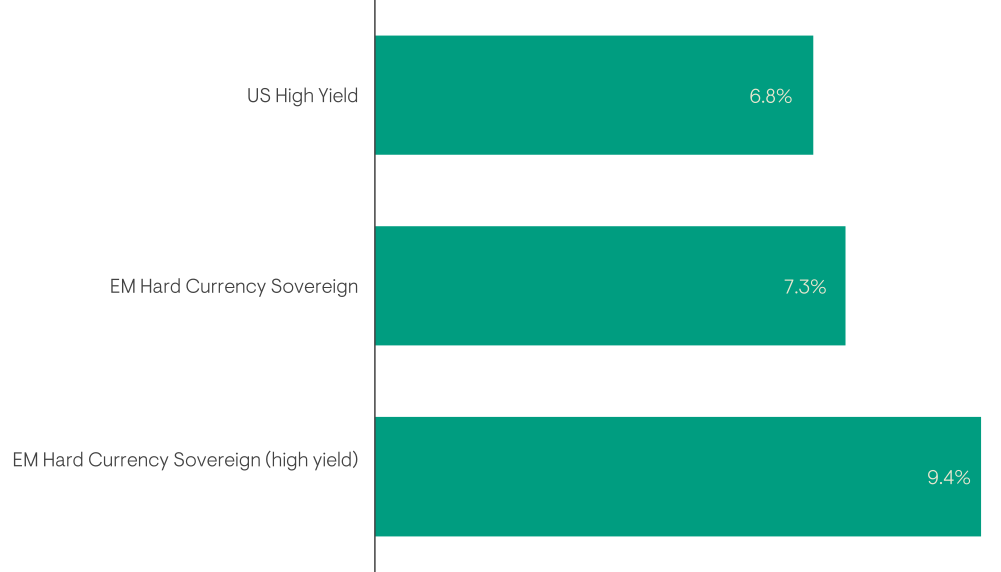
The chart below illustrates that the EM Hard Currency market (50% of which is investment grade) offers a yield pick-up of c.50bps relative to the US High-Yield market. A more like-for-like comparison – focusing only on the high-yield part of the EM Debt market – reveals an even more pronounced yield pick-up (c.250bps).
Figure 1: EM Debt offers a yield pick-up over US High-Yield Debt
Source: Bloomberg, JPMorgan, BofA, Ninety One, as of 31 August 2025. The chart focuses on the EM Hard Currency Debt market.
2. Strong fundamentals
The asset class has evolved and strengthened. Today, it is underpinned by robust governance dynamics. Despite lingering misperceptions, many EM policymakers have demonstrated greater fiscal discipline and earlier monetary policy action than their developed market peers. As a result, EM economies appear increasingly robust across a variety of metrics: debt to GDP stands at 81% (vs. 124% in the US), and the current account balance is at 0.3% surplus vs. the 3.1% deficit in the US1.
In addition to clear evidence of fiscal prudence among EM policymakers, EM monetary policy has also been disciplined. Drawing lessons from past inflation cycles, EM policymakers were among the first to respond to rising prices post-COVID-19 – a pattern that helped rein in inflation, stabilize real yields, and support local currency assets.
3. A deep and diversified market
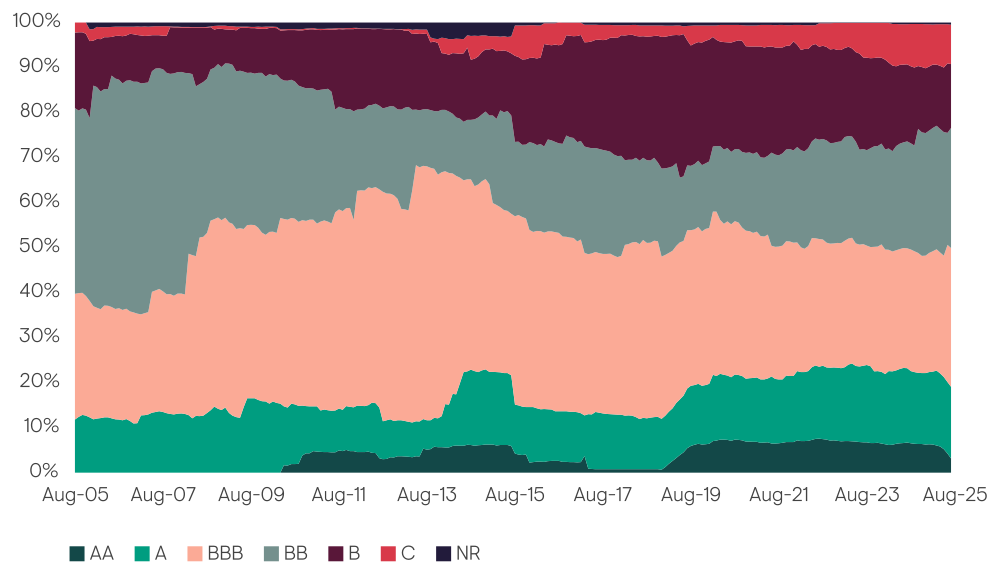
EM Debt has evolved over the past two decades into a significant and diversified segment of the global fixed income market. The flagship EM Hard Currency Debt index has become a truly global investment universe. The inclusion of predominantly investment grade Gulf Cooperation Council countries has lifted the Middle East’s share to around 16%, while fast-growing frontier markets now account for roughly 28%.
The EM Local Currency Debt market has also matured, spanning technology-driven economies, global manufacturing hubs, and commodity exporters. Credit quality has strengthened here as well, and a growing cohort of frontier markets offer active investors additional yield potential.
Figure 2: The EM Debt market offers robust credit quality
Source: JPMorgan EMBI, as of 31 August 2025. NR = not rated.
4. Compelling entry point
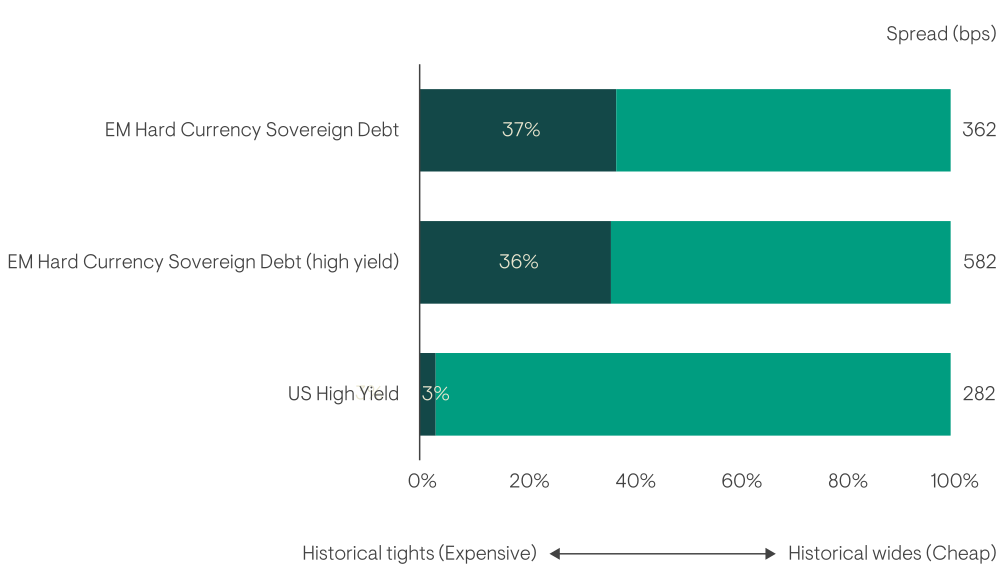
Beyond the long-term structural rationale for the asset class, current valuations and spreads further highlight the near-term opportunity, offering an attractive entry point for investors. Spreads in the EM Hard Currency Debt market are notably wider relative to their 10-year history than those in the US High-Yield market, where spreads are near their tightest levels. This suggests greater potential for credit spread compression compared with developed market credit.
Figure 3: EM Debt valuations remain compelling
Source: Bloomberg, JPMorgan, Ninety One Calculations, 31 August 2025.
5. Portfolio construction benefits
Each part of the EM Debt asset class has something distinct to offer investors as each is driven by specific economic forces. Investors who opt for a single, blended portfolio (e.g., comprising 50% EM Local Currency Debt, 25% EM Hard Currency Sovereign Debt and 25% EM Corporate Debt) can seek to better navigate the full EM cycle – benefiting from the divergent dynamics across the asset class while also capturing bottom-up selection opportunities across and within markets.
| EM debt component | Drivers |
|---|---|
| Local Currency Bonds (FX hedged) | Rate market moves: inflation, monetary policy, fiscal policy |
| EMFX | Balance of payments, growth, monetary policy, interest rate differentials |
| Hard Currency Bonds | Credit spread moves: growth, external balances, balance of payments, fiscal policy |
Source: Ninety One.
Portfolio construction considerations for US investors
- From US HY → Increasing diversification without sacrificing yield
- From Leveraged Loans → Global diversification, similar yields with improving fundamentals
- From Core Plus FI → Yield booster with differentiated return drivers
In conclusion
EM Debt has evolved and strengthened – it deserves a place in global credit portfolios. Today, the asset class offers a useful yield pickup, robust credit quality, and diversification benefits. Underpinned by disciplined fiscal and monetary frameworks, EM Debt stands on firmer footing than in previous cycles, and current valuations make the entry point attractive.
1 Source: IMF October 2024 WEO, JPMorgan benchmarks, Ninety One calculations. EM covers 19 emerging markets in the JPMorgan GBI-EM. Where applicable, data is weighted by GDP.
General risks. The value of investments, and any income generated from them, can fall as well as rise. Where charges are taken from capital, this may constrain future growth. Ongoing costs and charges will impact returns. Past performance does not predict future returns, losses may be made. If any currency differs from the investor's home currency, returns may increase or decrease as a result of currency fluctuations. Investment objectives and performance targets are subject to change and may not necessarily be achieved, losses may be made. Environmental, social or governance related risk events or factors, if they occur, could cause a negative impact on the value of investments.
Specific risks. Currency exchange: Changes in the relative values of different currencies may adversely affect the value of investments and any related income. Default: There is a risk that the issuers of fixed income investments (e.g. bonds) may not be able to meet interest payments nor repay the money they have borrowed. The worse the credit quality of the issuer, the greater the risk of default and therefore investment loss. Derivatives: The use of derivatives may increase overall risk by magnifying the effect of both gains and losses leading to large changes in value and potentially large financial loss. A counterparty to a derivative transaction may fail to meet its obligations which may also lead to a financial loss. Interest rate: The value of fixed income investments (e.g. bonds) tends to decrease when interest rates rise. Emerging market (inc. China): These markets carry a higher risk of financial loss than more developed markets as they may have less developed legal, political, economic or other systems.
