The fast view
- US equities remain a core strength.
Over the past decade they have delivered outstanding returns, supported by strong profitability and, more recently, mega-cap leadership. - Starting points now matter.
US equities trade at ~26x trend earnings versus 13x for ACWI ex-US, with benchmarks allocating nearly 70% to the US despite fundamentals closer to 40–50%. - Opportunities are broadening.
History shows high concentration is usually followed by weaker forward returns, while new growth tailwinds in Europe and Asia point to stronger prospects abroad. - Why active, why now.
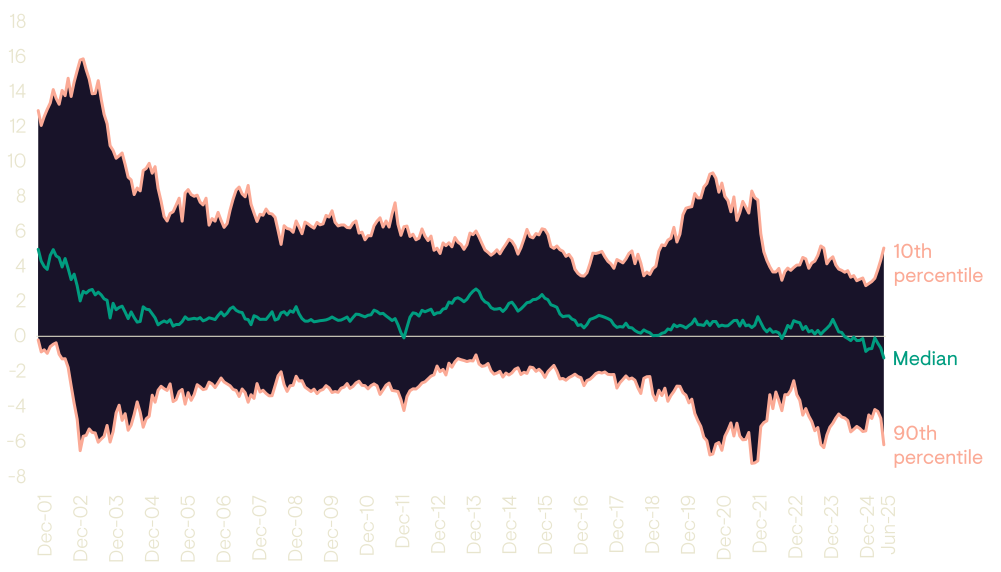
Dispersion across regions and sectors is widening. The median global large-cap manager has added +116bps annually over five-year periods, with consistent outperformers delivering more than +300bps. - Rebalancing improves outcomes.
Even a 5–10% shift from US to global raises expected portfolio returns, while a fundamentals-based 50/30/20 allocation (US/DM ex-US/EM) improves expected returns to 5.2% versus 4.7% for MSCI ACWI.
Introduction
For more than a decade, US equities have been the obvious place to be. Exceptional returns, underpinned by strong corporate profitability, a supportive policy backdrop and, more recently, the rise of a handful of mega-cap technology firms have left allocators with little incentive to look further afield. For many, this has meant portfolios that are heavily concentrated in the US, often with only a token exposure to global equities.
That strength is clear in the numbers. From 2010 to 2024, US equities compounded at nearly twice the pace of international peers1. Valuations followed: US equities now trade at 26x trend earnings compared with 13x for ACWI ex-US equities2. Market-cap benchmarks reflect the imbalance, with the US now accounting for almost 70% of global indices3 despite representing less than a quarter of global GDP4.
Broadening beyond US strength
Each cycle in equity markets has unique characteristics but the importance of building resilience and diversification into portfolios does not change. Today, valuation divergences, extreme concentration and diverging macro fundamentals all suggest there is a timely opportunity to complement existing US exposure with exposure in international markets.
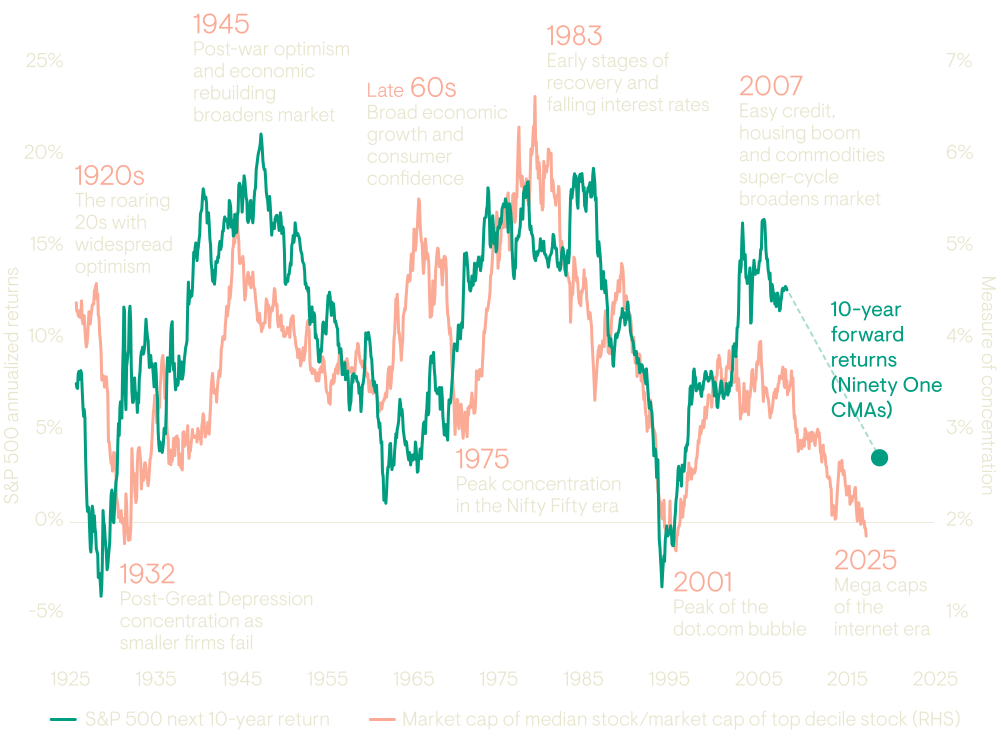
History shows why balance matters. Past peaks in concentration, from the Nifty Fifty in the 1970s to the dot-com bubble in 2001, were followed by years of weaker returns. Today, the largest 10% of US stocks command their biggest share of market capitalization in a century5, leaving portfolios heavily reliant on a handful of names.
Figure 1: High market concentration has historically signaled weaker future returns
Periods of extreme concentration, such as the Nifty Fifty and dot-com eras, were followed by lower 10-year equity returns
Source: Ninety One, Bloomberg, July 2025.
The premium attached to US equities has also been reinforced by extraordinary foreign inflows. International investors now hold US assets worth over US$60 trillion, leaving the US with a net liability position close to 90% of GDP — the highest on record. These flows have helped sustain valuations, but their very scale makes them fragile6. The key issue is how incremental savings and reserve allocations evolve. If new flows begin tilting more evenly across regions, the US premium could narrow.
At the same time, macro forces are creating new opportunities internationally. Europe has relaxed fiscal rules, enabling investment in defence and infrastructure with meaningful growth multipliers7 . Large Asian markets, including India, Korea and Taiwan, have far greater fiscal headroom than developed peers. And in China, policy priorities have shifted from infrastructure towards advanced manufacturing and consumption, sustaining new avenues for growth. Despite recent challenges, China’s consumer has been the largest single source of global growth this century, underscoring the scale of opportunity outside the US. Unlike the internet era, when investors focused on US technology companies, the emerging AI cycle is expected to distribute benefits more broadly across regions and sectors.
Why active matters now
This evolving environment creates challenges for passive strategies. Dispersion between countries, sectors and companies is widening, making it harder for index trackers to deliver balanced exposure.
Active managers, by contrast, can tilt towards under-appreciated opportunities and away from areas of excess. The range of outcomes among managers has been wide, but the best have consistently delivered strong excess returns. This widening dispersion highlights the value of selectivity and manager skill in concentrated markets8. In periods of concentration and divergence, the value of that selectivity only grows.
Figure 2: Global active managers have delivered consistent excess returns
Rolling 3-year excess returns for global large-cap equity managers vs. MSCI ACWI
Source: eVestment Global Large Cap Equity Universe, June 2025.
At the same time, macro forces are creating new opportunities internationally. Europe has relaxed fiscal rules, enabling investment in defence and infrastructure with meaningful growth multipliers. Large Asian markets, including India, Korea and Taiwan, have far greater fiscal headroom than developed peers. And in China, policy priorities have shifted from infrastructure towards advanced manufacturing and consumption, sustaining new avenues for growth. Despite recent challenges, China’s consumer has been the largest single source of global growth this century, underscoring the scale of opportunity outside the US. Unlike the internet era, when investors focused on US technology companies, the emerging AI cycle is expected to distribute benefits more broadly across regions and sectors.
Rethinking what diversification really means
Allocators often assume global benchmarks offer balance. In practice ‘global’ portfolios are heavily skewed toward US mega-caps. By fundamental measures such as revenues, earnings, cash flows and dividends, the US accounts for 40–50% of the global corporate sector, far below its near-70% share of benchmarks9. This gap highlights why relying on market-cap indices risks overweighting yesterday’s winners rather than tomorrow’s opportunities.
Our forecasts suggest this imbalance matters for returns. Ninety One’s ten-year Capital Market Assumptions forecast annualized nominal USD returns of 3.7% for US equities, 6.3% for developed ex-US and 7.2% for emerging markets. That divergence reflects higher starting yields, more attractive valuations and favorable currency dynamics outside the US.
The point is not to reduce US exposure dramatically, but to complement it with a stronger, active global core. Doing so reduces concentration risk and improves expected outcomes, even if the shift is incremental.
Looking ahead our capital market assumptions suggest an even clearer case
Over the next decade, US equities are expected to deliver 3.7% annually, compared with 6.3% for developed ex-US and 7.2% for emerging markets. A fundamentals-based allocation of 50% US, 30% developed ex-US and 20% emerging markets delivers a projected return of 5.2% - above the 4.7% expected from the MSCI ACWI benchmark.
Figure 3: Global balance improves expected returns
Our ten-year projections, in annualized nominal US dollar terms, suggest a clear divergence in return potential:
|
3.7%
US equities |
6.3%
Developed ex‑US equities |
7.2%
Emerging market equities |
The portfolio offering the highest risk-adjusted return comprises:
|
50%
US equities |
30%
Developed ex‑US equities |
20%
Emerging market equities |
For allocators willing to move further, the benefits grow. A fundamentals-based model allocation of 50% US, 30% developed ex-US and 20% emerging markets delivers an expected annual return of 5.2%, compared with 4.7% for the MSCI ACWI10. That extra half a percentage point each year compounds meaningfully over time.
A stronger equity core through global balance
US equities remain the anchor of global portfolios. But with valuations elevated, concentration at historic highs and macro fundamentals shifting, adding balance through an active, global allocation can improve resilience and return potential.
The goal is not to abandon US strength, but to complement it with broader exposure. By reintroducing regional breadth and active selectivity, allocators can build a more resilient equity core, one better positioned to capture the opportunities of the next phase.
1 MSCI ACWI, MSCI ACWI ex-US, Bloomberg.
2 Ninety One, Bloomberg, July 2025.
3 FTSE Russell All-World Index, July 2025.
4 IMF, GDP in current US dollar terms. At purchasing power parity, the IMF estimates that the US is less than 15% of global GDP.
5 Fama French data, Ninety One calculations.
6 Bloomberg, July 2025; US Bureau of Economic Analysis, NIIP data.
7 European Commission, IMF, July 2025.
8 eVestment’s Global Large Cap Equity Universe (gross returns, June 2025).
9 MSCI, Bloomberg; Ninety One calculations, December 2024.
10 The great rebalancing.
