Namibia
Select your role
Capital Market Assumptions - April 2026
Ninety One’s Capital Market Assumptions framework focuses on the key drivers of long-term performance. We do this to better understand possible future returns, enriching discussions with our clients.
8 May 2026
20 minutes
Ninety One’s Capital Market Assumptions framework focuses on the key drivers of long-term performance. We do this to better understand possible future returns, enriching discussions with our clients.
Our framework emphasises income payments across asset classes, as they are both readily measured and pivotal in determining returns. In addition, long-term history is available, and income is less subject to manipulation than accounting metrics.
We divide returns into three components. The first – income – is a tangible, known entity, but the others are subject to material misestimation:
| 1 | Income Yield is historically the single most important explanatory factor for income-generating assets |
| 2 | Growth The extent to which income is expected to change over time |
| 3 | Revaluation The price per unit of income likely to apply at the end of the period (typically, 10 years) |
Capital Market Assumptions - April 2026
Key takeaways

Six months ago, the global economy was in a rare Goldilocks phase, with growth accelerating across major regions and inflation gradually subsiding. The US tariff shock had proved largely manageable, and AI was already boosting growth through a sustained capital investment cycle.
That benign phase did not last. Since then, investors have had to contend with war in the Middle East, unprecedented disruption to global crude oil and natural gas flows, a wave of defaults and investor outflows from private credit portfolios and a reassessment of the downside risks associated with AI innovation.
Each of these developments has been a significant source of uncertainty and volatility. Prices for crude oil and distilled products doubled and, in some cases, tripled. The average software stock fell by a third, while the prices of publicly traded vehicles exposed to private credit imply an average impairment of 20% in the value of the predominantly senior secured loans held in these portfolios.
For all this, the impact on broad asset markets has been relatively muted. Bond yields have risen as expectations of interest rate cuts have given way to a renewed hiking cycle. Credit spreads have widened moderately and equity valuations have derated slightly, but none of these moves has materially altered the overall picture of muted expected returns.
We anticipate that a traditional 60% global equity, 40% global government bond portfolio, hedged into US dollars, will deliver an annualised nominal return of 3.9% over the next decade. That outcome would place it just above the bottom decile of historic 10-year returns.
We continue to see considerable scope for value-add through asset allocation and security selection.
Forecasts are inherently limited and modelling involves risks, assumptions and uncertainties, they are forward looking and are not guarantees nor a reliable indicator of future results. Actual returns could be materially higher or lower than projected. This information is not intended as a recommendation to invest in any particular asset class or strategy or as a promise of future performance.
Source: Ninety One proprietary Capital Market Assumptions as at 31 March 2026. These estimates are gross of fees (returns can be reduced by management fees and other expenses incurred) and reflect the view of Ninety One’s multi-asset team, whilst the views of other teams across Ninety One may differ. Details on our Capital Market Assumptions methodology available upon request.
Capital Market Assumptions - April 2026
Key takeaways
Financial markets have faced a confluence of risks from geopolitics, AI disruption and private credit, driving significant sector-specific volatility but leaving the low return outlook across global assets largely unchanged.
Six months ago, the global economy was in a rare Goldilocks phase, with growth accelerating across major regions and inflation gradually subsiding. The US tariff shock had proved largely manageable, and AI was already boosting growth through a sustained capital investment cycle.
That benign phase did not last. Since then, investors have had to contend with war in the Middle East, unprecedented disruption to global crude oil and natural gas flows, a wave of defaults and investor outflows from private credit portfolios and a reassessment of the downside risks associated with AI innovation.
Each of these developments has been a significant source of uncertainty and volatility. Prices for crude oil and distilled products doubled and, in some cases, tripled. The average software stock fell by a third, while the prices of publicly traded vehicles exposed to private credit imply an average impairment of 20% in the value of the predominantly senior secured loans held in these portfolios.
For all this, the impact on broad asset markets has been relatively muted. Bond yields have risen as expectations of interest rate cuts have given way to a renewed hiking cycle. Credit spreads have widened moderately and equity valuations have derated slightly, but none of these moves has materially altered the overall picture of muted expected returns.
We anticipate that a traditional 60% global equity, 40% global government bond portfolio, hedged into US dollars, will deliver an annualised nominal return of 3.9% over the next decade. That outcome would place it just above the bottom decile of historic 10-year returns.
We continue to see considerable scope for value-add through asset allocation and security selection.
Forecasts are inherently limited and modelling involves risks, assumptions and uncertainties, they are forward looking and are not guarantees nor a reliable indicator of future results. Actual returns could be materially higher or lower than projected. This information is not intended as a recommendation to invest in any particular asset class or strategy or as a promise of future performance.
Source: Ninety One proprietary Capital Market Assumptions as at 31 March 2026. These estimates are gross of fees (returns can be reduced by management fees and other expenses incurred) and reflect the view of Ninety One’s multi-asset team, whilst the views of other teams across Ninety One may differ. Details on our Capital Market Assumptions methodology available upon request.
Historical effectiveness
We tend to evaluate effectiveness in terms of getting the direction of travel correct.
Long-term predictions are fraught with uncertainty and open to error. We can, however, retrospectively apply our framework to assess its historical effectiveness. Because we focus on contextual information, we tend to evaluate effectiveness in terms of the reliability of the direction of the signal at market peaks or troughs; getting the broad direction of travel correct over a decade is a critical factor in an overall investment outcome.
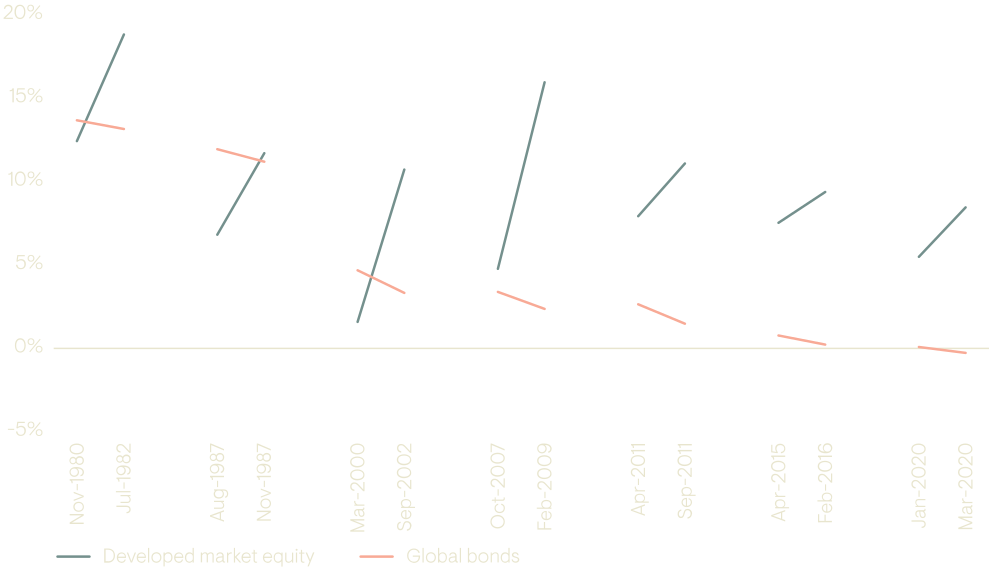
The figure below identifies a variety of market peaks and subsequent troughs, stretching back to 1980, for each of developed market equity and global bonds1. We then show the subsequent 10-year predicted returns at those points.
Figure 1: Expected returns can vary significantly depending on the point of the cycle
Source: Ninety One. Data is global since 2000; prior dates based on US outcomes. Bonds based on 10-year tenor.
For example, the first point on the previous chart corresponds to November 1980 (roughly a market peak) followed by a trough in July of 1982. The relevant 10-year forecasts in each instance were:
| Peak | Subsequent trough | |
|---|---|---|
| Developed market equity | 12.4% | 18.8% |
| Global bonds | 13.7% | 13.2% |
Indeed, global equities tripled in the decade from November 1980, and rose fourfold from July 1982. The chart illustrates the desired pattern — riskier assets tend to have lower anticipated 10-year returns at peak than they do at the subsequent trough; conversely, the more defensive bond asset tends to do better at the peak than the trough. Interestingly, although this pattern is repeated over time, it appears to be getting more compressed – perhaps due to the expansive liquidity provision over this period.
1 Developed market equities = MSCI World and global bonds = FTSE WGBI.
Fixed income
Prospective returns from fixed income assets have improved with slightly higher government bond yields and wider credit spreads.
The following chart examines fixed income assets in nominal, local currency terms, for 31 March 2026 versus our last update, six months ago:
Figure 2: Sovereign bond yields have edged up, and corporate credit spreads have widened
10-year local currency, return forecast
Source: Ninety One (internal calculations based on Bloomberg, JP Morgan and Moody’s data).
EMBI = Emerging Markets Bond Index, EM LC = Emerging markets local currency debt; US IG = US investment grade;
US HY = US high yield; CEMBI = Corporate Emerging Markets Bond Index.
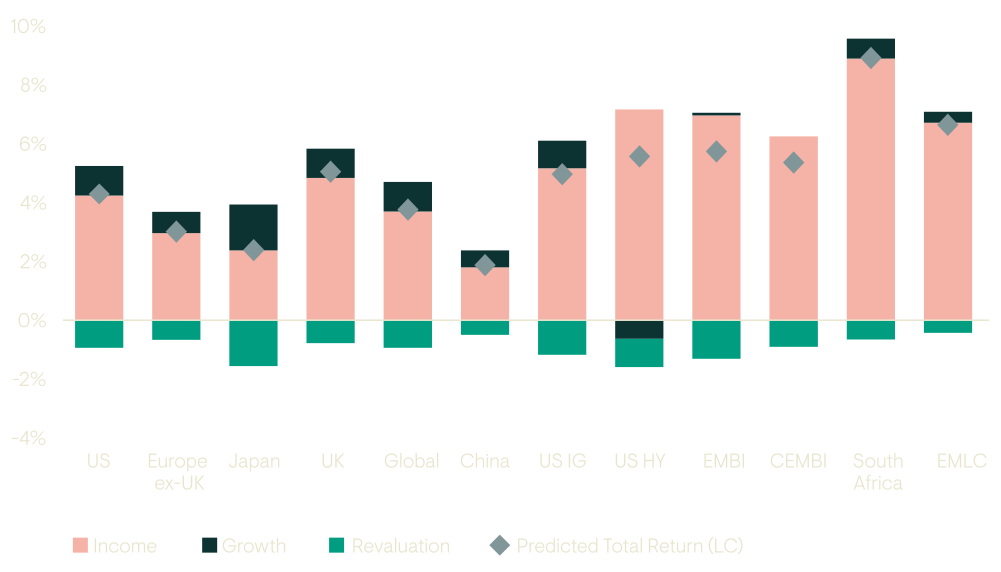
Prospective returns from government bonds have increased slightly across most developed and emerging markets. Yields on Japanese government bonds increased the most while South African yields declined slightly over the period, having initially moved significantly lower before rising sharply in March. Credit spreads have increased but remain well below long-term average levels. The combination of higher US Treasury yields and wider spreads has increased prospective returns from both US high yield and EM corporate bonds by 1.0% over the last six months.
Risk-free yields remain consistently lower than those implicit in forward yield curves, leading to negative revaluation effects across the board. Yield curves have flattened modestly but remain upward sloping with positive prospective roll returns.
The following chart provides more detail on our return forecasts, dissecting fixed income regions in the context of our Capital Market Assumptions framework pillars: income, growth, and revaluation.
Figure 3: Income accounts for the bulk of return potential across fixed income
Source: Ninety One (internal calculations based on Bloomberg, JP Morgan and Moody’s data).
US IG = US Investment Grade; US HY = US High Yield; EMBI = Emerging Markets Bond Index; CEMBI = Corporate Emerging Markets Bond Index; EMLC = Emerging Market Local Currency.
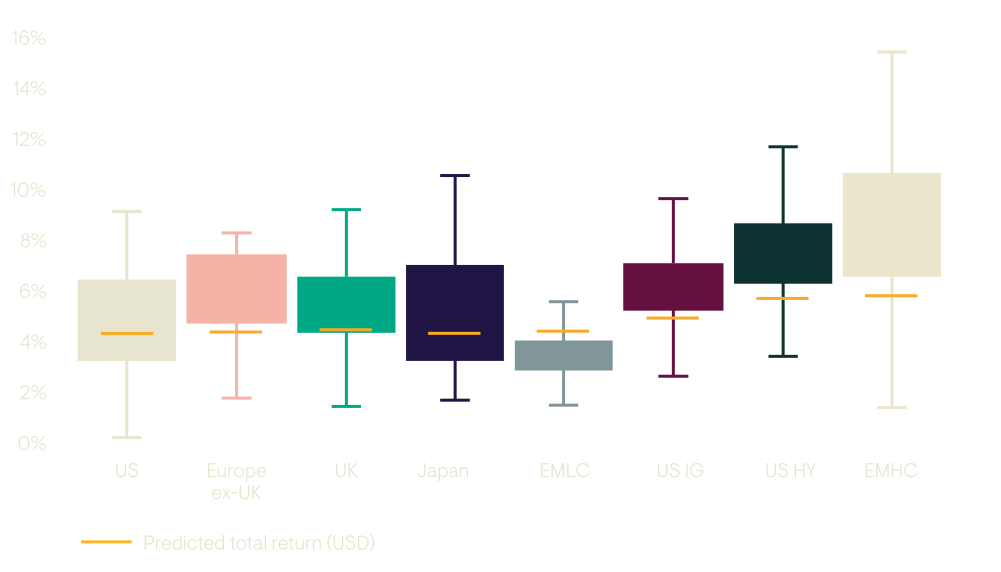
To better understand the relative attractiveness of prospective returns across fixed income markets, it is helpful to consider our return forecasts in the context of each market’s historical range of outcomes.
Figure 4: Return distribution of 10-year rolling historic returns
Source: Ninety One proprietary Capital Market Assumptions as at 31 March 2026.2
- The chart above shows the distribution of historic 10-year rolling geometric returns, hedged into USD, for the assets (in the box-and-whisker plot) versus the current forecast (yellow bar).
- The body of the box represents the interquartile range, while the ‘whiskers’ extend to the maximum and minimum historic rolling 10-year returns.
- It is evident that, bar EM LC (top quartile), fixed income returns are predicted to be consistently below historic median returns.
2 Based on monthly data from December 1987 to March 2026. Estimates are nominal, hedged into USD, gross of fees and ignore alpha. Modelling involves risks, assumptions and uncertainties. These estimates reflect the view of Ninety One’s multi-asset team, while the views of other teams across Ninety One may differ. Performance does not guarantee future results. Actual returns could be materially higher or lower than projected. For information on our Capital Markets Assumptions methodology, please see Important information.
EMLC = Emerging Market Local Currency; EMHC = Emerging Market Hard Currency; US HY = US High Yield; US IG = US Investment Grade.
Equities
Unusually high dispersion at the regional and sector level has left prospective returns modestly higher on average but with notable divergences across markets.
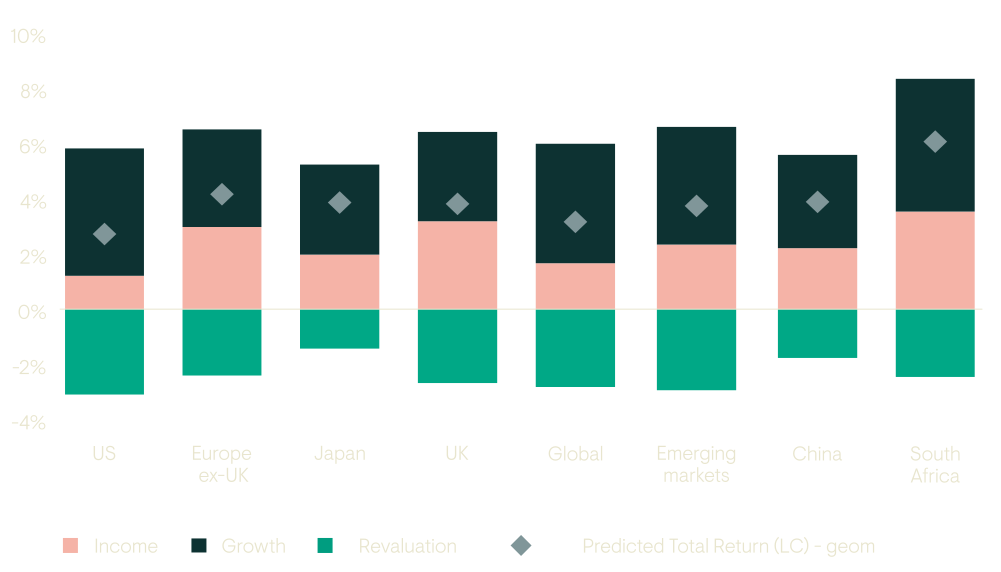
Prospective returns have increased for global equities in the past six months. Despite strong underlying growth, valuations have derated even as global indices have remained essentially unchanged over the period. The flat return from MSCI AC World masks dramatic intramarket dispersion: MSCI Korea returned 62% over the six months, while MSCI China fell 15% in local currency terms. At the sector level, Global Energy gained 38% while Global Consumer Discretionary lost 11% in US dollars.
In developed markets, double-digit returns from Japan and the UK led to a reduction in prospective returns while the US market saw the largest derating and, as a result, a significant increase in expected returns. Despite this, the US remains the most expensive equity market relative to its own history and offers the lowest prospective return as a result.
The correction in the Chinese equity market has reduced the expected drag from valuation mean reversion, leading to a meaningful uplift in prospective returns for China relative to our last update. Emerging markets ex China, by contrast, have enjoyed a period of strong returns and higher valuations, with the net effect that prospective returns for the global emerging markets index are little changed over the period.
The following chart shows forecast returns for equity markets in nominal, local-currency terms, as at 31 March 2026, compared with those in our last update, six months ago.
Figure 5: Equity: 10-year local currency return forecast
Performance does not guarantee future results. Actual returns could be materially higher or lower than projected.
Source: Ninety One (internal calculations based on Bloomberg data).
Modestly higher expected returns from global equities do not change the fact that the outlook for returns remains firmly at the low end of historic 10-year outcomes.
Figure 6: Growth dominates return expectations, with revaluation uniformly negative
Performance does not guarantee future results. Actual returns could be materially higher or lower than projected.
Source: Ninety One (internal calculations based on Bloomberg data). Estimates are nominal, gross of fees and ignore alpha.3
To give a further understanding of the relative attractiveness of prospective returns across equity markets, it is helpful to consider our return forecasts in the context of the historic range of outcomes for each market.
Figure 7: Return distribution of 10-year rolling historic returns
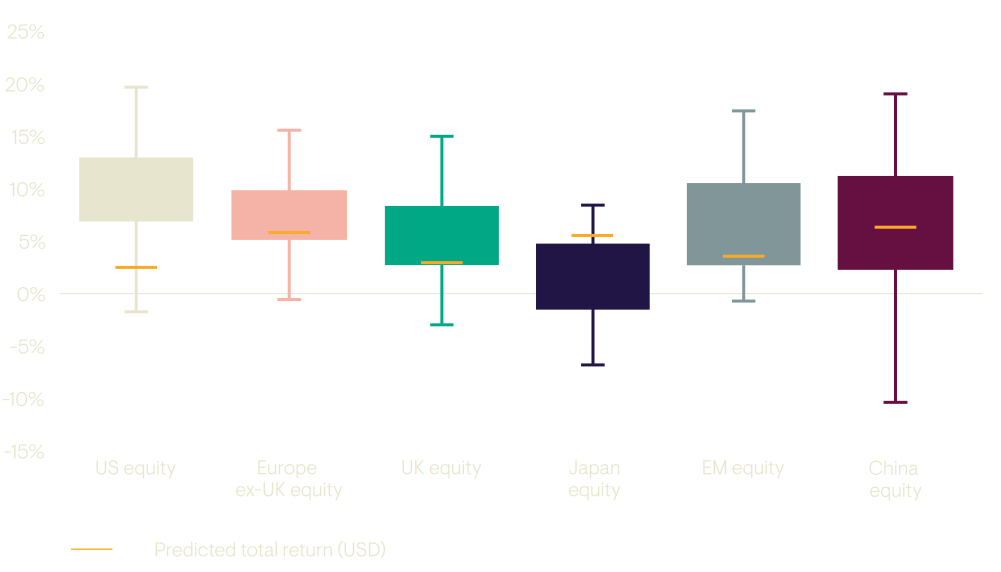
Source: Ninety One proprietary Capital Market Assumptions as at 31 March 2026.4
- The chart above shows the distribution of historic 10-year rolling geometric returns, hedged into USD, for the assets (in the box-and-whisker plot) versus the current forecast (yellow bar).
- The body of the box represents the interquartile range, while the ‘whiskers’ extend to the maximum and minimum historic rolling 10-year returns.
- While forecast equity returns do not generally look attractive in an absolute sense, Japan stands out on this basis, with expected returns in the top quartile of recent history, whereas the US is comfortably in the lowest quartile versus its recent history and other markets in their second quartile.
3 The final total returns are converted from logarithmic to geometric estimates. This means that the components of the return breakdown may not sum to the total return. Judgmental overrides may apply where deemed necessary – for example as currently applied to China where we expect growth over the next ten years to be slower than that implied by historic trend GDP per capita growth. Modelling involves risks, assumptions and uncertainties. These estimates reflect the view of Ninety One’s Multi-Asset team, while the views of other teams across Ninety One may differ. For information on our Capital Markets Assumptions methodology, please see Important information. Return breakdowns in local currency.
4 Based on monthly data from December 1987 to March 2026. Estimates are nominal, hedged into USD, gross of fees and ignore alpha. Modelling involves risks, assumptions and uncertainties. These estimates reflect the view of Ninety One’s multi-asset team, while the views of other teams across Ninety One may differ. Performance does not guarantee future results. Actual returns could be materially higher or lower than projected. For information on our Capital Markets Assumptions methodology, please see Important information.
Case study: Technological revolutions and equity returns
AI has become the defining equity market story of the past two years, but history suggests that major technological shifts do not translate neatly into broad market gains. In this case study, we look back at earlier episodes of technological disruption to understand how value was destroyed, created and redistributed across equity markets, and what that may tell us about the range of possible outcomes from today’s AI transition.
Artificial intelligence has been the dominant driver of the equity market narrative since the launch of ChatGPT in November 2022. In the early phase of this cycle, the market response was one-dimensional — AI innovation was an unambiguously positive force for equity returns. The largest gains accrued to large-cap US technology and internet companies leading innovation, but investors also rewarded businesses exposed to the build-out of supporting infrastructure, including semiconductors, technology hardware, data centres and the construction and energy providers needed to support them.
The enormous capital investment undertaken by these companies was widely expected to strengthen already dominant competitive positions and support a further uplift in earnings across the broader AI ecosystem. There has since been extensive debate about whether this wave of investment will ultimately generate attractive economic returns. That is an important question, but not one we seek to resolve here. The answer will depend on how AI technology evolves, how quickly adoption broadens and how successfully early leaders convert heavy spending into durable cash flows.
The rapid improvement in AI capabilities has shifted market attention from the direct beneficiaries of the investment boom to the disruptive consequences of this innovation. The risk that existing business models will be displaced by new AI-enabled workflows, products and services has become impossible to ignore and some degree of creative disruption is unavoidable. Understanding which companies and sectors are likely to be left behind and which may prosper will require detailed bottom-up analysis beyond the scope of our capital market assumptions framework.
AI can feel like a uniquely futuristic technology, making historical comparison unhelpful. Yet a core principle of our CMA work is that the past remains a useful guide to a range of future outcomes. No historical analogy will map neatly onto AI, but previous technological transitions can still help frame the possible balance between value lost in disrupted sectors, value created in emerging industries and the net effect on equity market returns through the period of development and adoption.
We therefore look back at a range of historical technological revolutions in which the impact was sufficiently visible in listed equity markets to identify both relative winners and relative losers. This is an important qualification. The historical episodes we examine are not necessarily the most consequential innovations in economic history, but rather those where equity market data provides a reasonably clear record of the transition.
The historical analogues we explore are:
- The build-out of rail networks and the associated decline of waterborne transport, visible through disruption to canal businesses.
- The mass adoption of the automobile, which almost immediately replaced horse and carriage travel, but over time took both passengers and freight away from rail.
- Mass availability and affordability of electronic home appliances, focusing on the specific example of television ownership dramatically reducing cinema visits.
- The birth of the internet, which had broad impacts across retail, media, advertising and other sectors and is most easily isolated through its impact on the publishing industry.
The first and perhaps most obvious lesson we can draw is that the pace of technological change continues to accelerate. 2025 was a significant milestone in the development of AI as it marked the point at which adoption by US consumers passed 50%.5 (Adoption by businesses and across global consumers has been somewhat slower.) Generative AI hit this level three years after widespread commercial availability. This appears to be the fastest adoption rate of any major technological innovation in the last 200 years, with a trend towards ever faster adoption rates over this period:
- It took at least 30 years to build out 50% of the rail networks in the US and UK in the middle of the 19th century.
- Seventeen years passed from the launch of the Ford Model T in 1908 until 50% of US households owned a car by 1925.
- Adoption rates for home appliances varied, but the refrigerator and the television were among the fastest, with each taking about 10 years from the start of mass adoption to 50% US household ownership.
- The first consumer internet ISP services were launched in 1992, and US household access passed 50% in 2002.
Figure 8: The pace of technological adoption accelerates over time
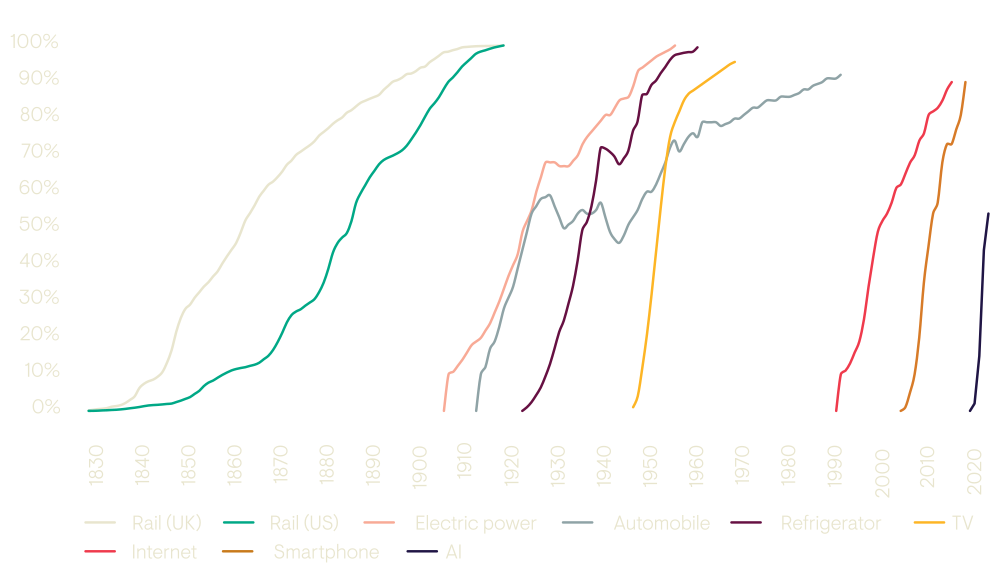
Sources: National Bureau of Economic Research, Historical Cross Country Technology Adoption Database (Horace Dediu; Comin and Hobijn), Real -Time Population Survey. 31 December 2025.
We now turn to the return outcomes observed through these historical technological transitions. For each example, we have calculated returns for the technological winners, losers and the overall market, and have broken the transition period into two phases: the initial innovation phase from the start of mass adoption to 50% adoption, and the maturity phase from 50% adoption to full adoption. In line with our CMA framework, we have decomposed returns into contributions from income, growth and valuation.
Care should be taken when interpreting these results, as they span very different historical eras and market segments; the sample size is small and each transition has unique characteristics.
The table shows the average annualised returns across the four historical transitions expressed in nominal local currency terms.6
Return drivers across technological adoption phases
| Adoption <50% | Adoption >50% | Full period | |||||||
|---|---|---|---|---|---|---|---|---|---|
| Market | Old tech | New tech | Market | Old tech | New tech | Market | Old tech | New tech | |
| Income | 4% | 4% | 4% | 4% | 3% | 4% | 4% | 4% | 4% |
| Growth | 4% | 2% | 18% | 3% | -4% | 6% | 3% | -1% | 12% |
| Valuation | 2% | 0% | -7% | 0% | 3% | -1% | 1% | 1% | -4% |
| Total return | 10% | 7% | 16% | 7% | 2% | 9% | 9% | 4% | 13% |
Source: Ninety One research, 31 December 2025. The underlying data sources and academic research informing these calculations are detailed in the tables for the individual historical examples.
Starting at the market level, total returns over the full course of a technological transition have been very similar to the long-run average for the US equity market. Studies of returns over the last 100 to 200 years estimate annual total returns of 8-10% in nominal terms and 6-7% in real terms.7 On average, returns were higher in the initial adoption period and lower in the later, more mature phase of the technology cycle. This reflects a combination of slightly slower growth and less favourable valuation adjustment in the second phase of the transition.
For the incumbent technology, slow growth and unchanged valuations produce below-market returns in the initial phase. Disruption intensifies once adoption of the new technology passes 50%: growth turns mildly negative, income declines somewhat, and even a positive contribution from valuations cannot prevent a very weak total return outcome.
For the new technology, strong growth underpins very strong returns in the first phase of adoption and more than offsets the de-rating that occurs. Growth slows sharply as technologies mature but, in these examples, remains well above market growth throughout the second half of the transition. Returns in the later period are somewhat higher than the market, but only in line with long run averages.
These average figures conceal the nuances and specific factors that made each technological revolution unique. The case studies that follow set out the key features of each transition and show how these fundamental changes shaped the eventual return outcomes for both the disruptors and the disrupted.
From these case studies, we draw several broadly applicable lessons that help frame the outlook for equity markets in a time of AI-driven disruption.
For the disrupted sectors, three factors are key. Each suggests that the challenge facing companies exposed to AI disruption may be greater than in the average historical transition.
The first is the scale of market capitalisation at risk, which is not directly linked to the socio-economic importance of a technological innovation. In our historical examples, canals were the most significant market segment to be disrupted, accounting for more than 60% of UK equity market capitalisation in 1830. In contrast, the disruptive effects of automobiles and home appliances were more limited in market terms because, for the most part, the losers were small local businesses rather than large, listed companies. AI disruption risk lies somewhere between these two extremes, and the possibility of widespread disruption should not be dismissed. Based on the GICS sub-industries where markets have already begun to price in AI disruption fears, around 33% of MSCI AC World market capitalisation is at some risk of AI disruption.
Second, time is an important asset for incumbents. The longer the transition takes, the greater the opportunity for disrupted businesses to maximise the returns from their existing assets before customers fully switch. Canals, for example, had decades to exploit their installed networks as railroads were built out. In some cases, a more prolonged and visible technological change also gives incumbents enough time to adapt and succeed in the new paradigm. Radio broadcasters such as RCA, CBS and ABC had time to adapt their infrastructure for the shift to television, as technological change ran well ahead of consumer adoption, which accelerated only once prices fell and availability improved. The pace of internet disruption varied across sectors: the shift in retail spending from offline to online has been much slower than the shifts in advertising spend or media consumption, with only 19% of US retail sales taking place online in 2025.8 As a result, some bricks-and-mortar retailers, although initially slow to respond to the challenge of e-commerce, have successfully pivoted to omnichannel models that can compete with online-only offerings. In contrast, the pace of change in the AI revolution suggests that time may not be on the side of incumbents.
Third, income matters. In our examples, businesses built around the disrupted technology were, on average, able to maintain dividend yields in line with, or close to, the market throughout the period of disruption. This was vital to their ability to continue generating returns for shareholders, especially once their businesses began to shrink outright later in the technological transition. Current dividend income levels are much lower than in our historical examples, with the global market yielding 1.7% as at 31 March 2026. The software sector, at the centre of current disruption fears, is among the lowest yielding of all, with a dividend yield of just 0.7%, while also expending significant cash on buybacks to offset dilution from high levels of stock-based compensation. For a business in gradual decline, the optimal capital allocation strategy is often to prioritise shareholder returns over reinvestment. From a market perspective, that can also support valuations, as it attracts an income seeking investor base and higher payout ratios can signal management confidence in the sustainability of current dividends. This may help explain why, on average, valuation became a positive driver of returns for disrupted sectors later in the disruption period. For many of the companies now seen as most at risk of disruption, however, such an approach would represent a dramatic strategic shift. That strengthens the case that income may offer less support to returns this time around.
For the disruptors, our case studies reveal two features which may not be well understood by investors.
First, the ability to deliver growth and total returns well above market levels falls sharply as the transition matures. A slowing growth trajectory as a technology matures is intuitive, but the scale of the downshift was dramatic in our historical examples. The distinction between the periods before and after 50% adoption suggests that investors should be careful about extrapolating recent growth rates for AI companies too far into the future. Alongside slower growth, excess returns also decline notably in the second phase of adoption, with total returns only slightly above the market.
Second, returns often accrue to a small number of winners and the average company on the right side of technological change does not necessarily outperform. This lesson is clear in the most recent historical example, where internet platforms were the beneficiaries of powerful network effects and economies of scale, such that a single platform came to dominate each key vertical: Alphabet in search, Meta in social media and Amazon in e-commerce. This concentration of returns was also a feature of the early automobile market. Ford, the most successful early automaker, had a market share as high as 60% in the early 1920s but remained a private, family-owned business until 1956 – an interesting parallel with the venture capital ownership of many of the leading AI businesses. Performance in the listed auto sector was also heavily skewed: General Motors returned 29% per annum over the period; excluding GM, listed automakers returned a still-strong but much lower 9% per annum.
At the market level, returns have varied widely across technology revolutions, with underlying economic conditions and starting valuations always playing an important role in determining overall outcomes. Overall, we find no evidence that periods of technological transition are associated with stronger-than average returns. If anything, our case studies suggest that equity returns may be biased towards weaker-than-average outcomes once adoption of a major new technology passes 50%.
Canals to railways
The UK equity market was the world’s largest throughout the 1800s9, and equity issuance was a vital financing mechanism for the build-out of first a nationwide canal network and then of an equally expansive rail network. British canal companies delivered strong returns during their golden age from the late eighteenth century into the 1820s, and by that point canals accounted for more than 60% of UK market capitalisation.
From the mid-1820s, however, railways began to displace canals as the dominant transport technology. Canal market capitalisation fell by more than half between 1830 and 1860, but the shareholder experience was less severe than this decline in economic relevance might suggest. Because many canal businesses continued to generate cash and pay healthy dividends, total returns remained positive. Railway shares, meanwhile, experienced their own boom-and-bust cycle: prices more than doubled during the Railway Mania from 1843 to 1845 before surrendering those gains in the subsequent crash.
The expansion of the US rail network followed slightly after, financed by successive waves of speculative capital that repeatedly overbuilt ahead of demand, triggering major bankruptcies after the panics of 1857, 1873, and 1893. We focus on the UK experience as the better example of disruption to existing infrastructure and because of the more sizeable and mature UK equity market at the time.
Railways to automobiles
The automobile was the defining technological breakthrough of the early twentieth century, but the businesses most directly disrupted were wagon and carriage owners and manufacturers, which were mostly small private firms rather than listed companies.
Railways were also affected, particularly on the passenger side, while freight proved more resilient in the early stages. On the other side of the transition, the strongest returns from the new technology were heavily concentrated in a narrow group of winners. Ford, the most successful early automaker, was not listed until 1956, while performance in the listed sector was dominated by General Motors, which returned 29% per annum over the period; excluding GM, listed automakers returned a still-strong but much lower 9% per annum.
Auto innovation also helped to fuel excessive speculation in the US equity market in the 1920s, and the sector was particularly hard hit during the Great Depression. Automobile adoption stalled after the 1929 market crash, and it took another 20 years for adoption rates to surpass that initial peak.
Cinema to television
Widespread access to electric power and rising consumer incomes brought home appliances within reach of the average US household in the middle of the twentieth century. Refrigerators, washing machines and air conditioning reshaped daily life and created major new consumer industries. We highlight the example of television, given its disruptive impact on the large and highly profitable motion picture industry in the US. From the end of World War II to the early 1960s, annual movie theatre admissions fell from over four billion to around one billion. Several major studios faced severe financial distress, and the sector traded at depressed valuations for much of the period. The movie studios that survived adapted and eventually became core assets of diversified media conglomerates.
The technological innovators we focus on are TV set manufacturers, including RCA, Zenith, Westinghouse and Magnavox. They started out as manufacturers of radios, so were at risk of disruption themselves, but were early to recognise the potential of the cathode-ray tube and worked towards the commercialisation of the technology. The three large US broadcast networks were similarly adept in navigating the shift from radio to TV.
The internet and publishing
The commercialisation of the internet from the mid-1990s was transformative for telecoms, media, advertising and retail, but the disruptive impact was felt most acutely in the publishing industry. Newspaper advertising revenue — the economic engine of the industry — peaked in the US at close to US$50 billion in 2005 and collapsed by 70% over the following decade.10 Listed newspaper companies lost most of their market value; several filed for bankruptcy. Other offline businesses saw similarly rapid falls into obsolescence – sales of physical audio and video media declined precipitously and department stores and travel agencies disappeared from many city centres. The disruption was not uniform; some categories of retail proved less suited to e-commerce, while other large retailers used their existing scale, brand and logistics expertise to pivot to successful omnichannel models. As old forms of media distribution declined, the value of the strongest IP assets was retained or even enhanced by the ability to broadcast to a global audience at minimal incremental cost.
On the winning side, returns were heavily concentrated: by the 2010s, a handful of platform businesses captured the bulk of the value created, but only after numerous early internet companies — and their investors — were wiped out in the dot-com crash.
What history tells us
Taken together, these historical examples suggest that AI is likely to generate substantial value within a relatively narrow group of winners, while also driving value erosion across disrupted sectors. The net effect on overall equity market returns will therefore depend on the balance between these forces over the course of the adoption cycle, rather than implying a uniformly stronger return environment.
Canals to railways
| 1830 – 1860 Adoption <50% |
1860 – 1890 Adoption >50% |
1830 – 1890 Full period |
|||||||
|---|---|---|---|---|---|---|---|---|---|
| UK | Canals | Railways | UK | Canals | Railways | UK | Canals | Railways | |
| Income | 4% | 4% | 6% | 6% | 4% | 6% | 5% | 4% | 6% |
| Growth | 0% | 0% | 5% | 0% | -1% | -1% | 0% | 0% | 2% |
| Valuation | 0% | 0% | -5% | 0% | 1% | 1% | 0% | 0% | -2% |
| Total return | 5% | 3% | 7% | 6% | 4% | 6% | 5% | 4% | 6% |
| Inflation | 0% | 0% | 0% | ||||||
| Real return | 5% | 4% | 7% | 6% | 4% | 6% | 5% | 4% | 6% |
Source: Campbell, Gareth; Grossman, Richard S.; Turner, John D. (2019) Before the cult of equity: New monthly indices of the British share market, 1829-1929, QUCEH Working Paper Series, No. 2019-01, Queen’s University Centre for Economic History. UK Office for National Statistics.
Railways to automobiles
| 1911 -1925 Adoption <50% |
1925 -1939 Adoption >50% |
1911-1939 Full period |
|||||||
|---|---|---|---|---|---|---|---|---|---|
| US | Rail | Autos | US | Rail | Autos | US | Rail | Autos | |
| Income | 6% | 6% | 5% | 4% | 4% | 6% | 5% | 5% | 5% |
| Growth | 2% | 1% | 24% | -2% | -12% | -3% | 0% | -6% | 11% |
| Valuation | 1% | -1% | -5% | 1% | 3% | 6% | 1% | 1% | 0% |
| Total return | 9% | 6% | 28% | 4% | -4% | 9% | 6% | 1% | 18% |
| Inflation | 5% | -2% | 1% | ||||||
| Real return | 4% | 1% | 23% | 5% | -3% | 10% | 5% | -1% | 17% |
Source: The Cowles Commission for Research in Economics. Lawrence H. Officer and Samuel H. Williamson, The Annual Consumer Price Index for the United States, 1774-Present.
Cinema to television
| 1945 - 1955 Adoption <50% |
1955 - 1965 Adoption >50% |
1945 - 1965 Full period |
|||||||
|---|---|---|---|---|---|---|---|---|---|
| US | Cinema | TV | US | Cinema | TV | US | Cinema | TV | |
| Income | 6% | 7% | 5% | 3% | 3% | 3% | 4% | 5% | 4% |
| Growth | 9% | 3% | 11% | 5% | -5% | 4% | 7% | -1% | 7% |
| Valuation | 1% | -4% | -1% | 2% | 13% | 4% | 1% | 4% | 1% |
| Total return | 16% | 6% | 16% | 11% | 11% | 11% | 14% | 8% | 14% |
| Inflation | 4% | 2% | 3% | ||||||
| Real return | 12% | 2% | 12% | 9% | 10% | 10% | 11% | 6% | 11% |
Sources: Eugene F. Fama and Kenneth R. French, Robert Shiller, US Bureau of Labor Statistics.
Print to online media
| 1993 - 2003 Adoption <50% |
2003 - 2018 Adoption >50% |
1993-2018 Full period |
|||||||
|---|---|---|---|---|---|---|---|---|---|
| US | Publishing | Internet | US | Publishing | Internet | US | Publishing | Internet | |
| Income | 2% | 1% | 0% | 2% | 2% | 1% | 2% | 2% | 1% |
| Growth | 3% | 6% | 32% | 8% | 0% | 23% | 6% | 2% | 27% |
| Valuation | 5% | 5% | -19% | -2% | -4% | -13% | 1% | -1% | -15% |
| Total return | 11% | 12% | 14% | 8% | -1% | 11% | 9% | 4% | 12% |
| Inflation | 2% | 2% | 2% | ||||||
| Real return | 8% | 10% | 12% | 6% | -3% | 9% | 7% | 2% | 10% |
Source: Eugene F. Fama and Kenneth R. French, Standard & Poors, Nasdaq, US Bureau of Labor Statistics.
5 Generative AI Adoption Tracker
6 Full breakdown of the returns for each of the historical examples are provided in the appendix, including returns in both nominal and real terms.
7 See for example, work by Dimson, Marsh and Staunton, Robert Shiller and Jeremy Siegel.
8 Source: Census Bureau Quarterly Retail E-Commerce Sales report Q4 2025.
9 Stock Market Capitalization over the Past 250 Years: The Dominance of the Anglo Countries - Finaeon
10 Pew Research Center.
Currency
The currency decision – particularly whether to use ‘hedging’ or ‘conversion’ – can have a material impact on the outcome.
While we calculate our expected returns on a ̒local currency’ basis, we appreciate that clients need to make a currency decision – whether to hedge or not. We therefore present each of our equity and fixed income assumptions on two bases: hedged (using interest rate parity) and unhedged/converted (based on real exchange rate reversion).
Figure 9: Fixed income expectations
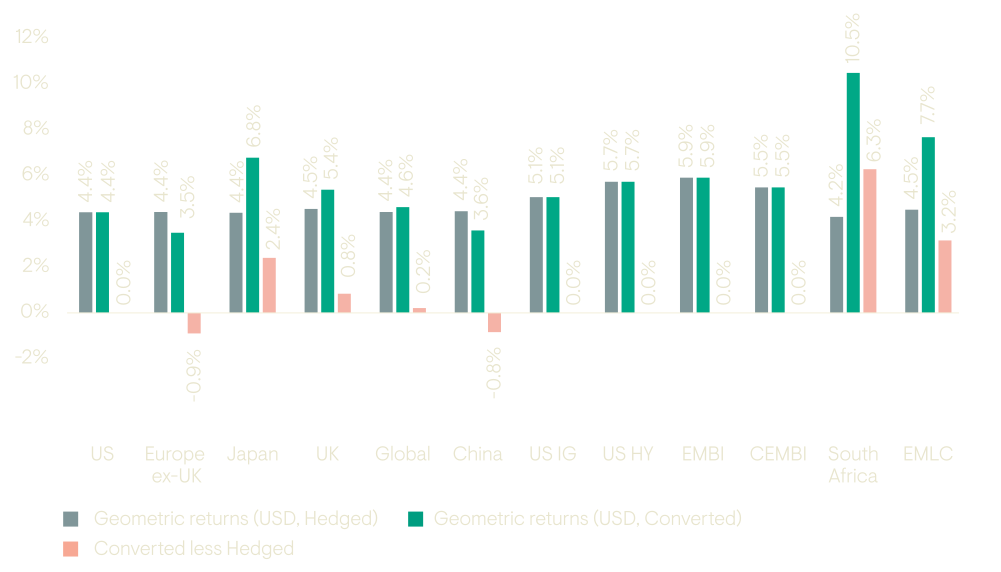
Source: Ninety One (internal calculations based on Bloomberg and JP Morgan data).
US IG = US Investment Grade; US HY = US High Yield; EMBI = Emerging Markets Bond Index; CEMBI = Corporate Emerging Markets Bond Index; EMLC = Emerging Market Local Currency.
Figure 10: Equity expectations
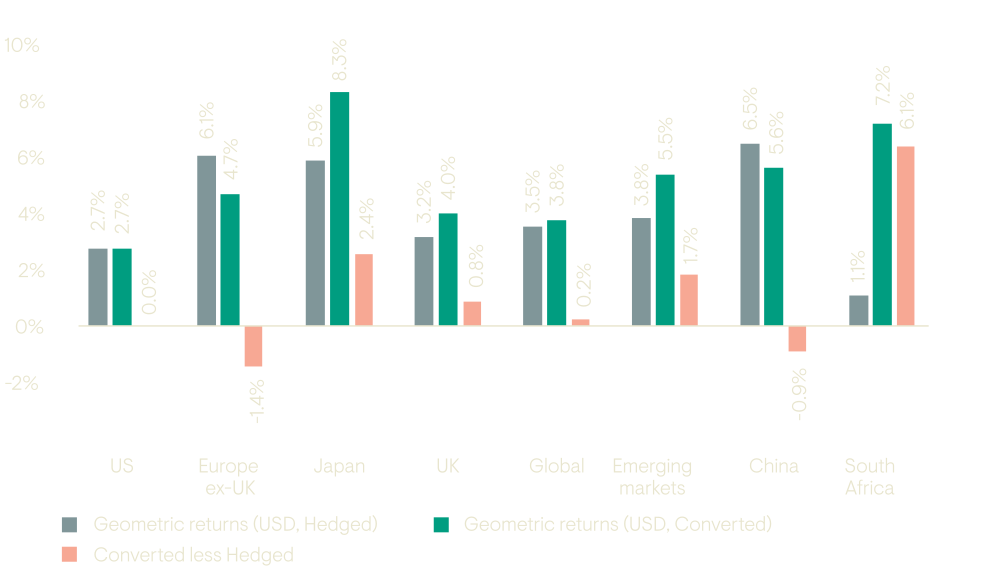
Source: Ninety One (internal calculations based on Bloomberg data).
Methodology
We focus on fundamentals. We divide returns into three components. The first is known and widely available, but the other two are subject to material misestimation.
Predicting long-term returns is fraught with difficulty; market values are not only determined by fundamentals, but also sentiment and exogenous events. We aim to keep things as straightforward as possible, and therefore focus on fundamentals. We:
|
Favour simplicity to capture the key drivers and accept wide uncertainty bands |
Strive for consistency with the investment process, focusing on cash flows |
Aim to be comprehensive across asset classes, with the ability to extend within |
We divide returns into three components. The first is known, more readily measured and widely available in the public domain, but the other two are subject to material misestimation:
|
Income – yield is the single most important explanatory factor for income-generating assets |
Growth – the extent to which income will likely change over time |
Revaluation – the price per unit of income likely to apply at the end of the period |
By default, we assume a 10-year investment horizon, to reflect the fact that we are long-term stewards of client capital. We do not consider tax, given different requirements pertaining to different mandates. The approach we outline is our baseline estimate; we may make judgmental adjustments to the underlying drivers if warranted.
Our approach mimics that of a systematic investor, buying the entire market.
Here we set out our methodology for equities, fixed income and currencies:
|
|
Equities |
Sovereign debt and credit |
|---|---|---|
|
Income |
Current dividend yield |
Current yield on notional bond13 |
|
Growth |
Nominal GDP per capita11 growth plus Market composition impacts (IPOs, M&A, index inclusion events etc)12 (Each based on a 15-year historic trend) |
Anticipated change in yield based on market-inferred future risk-free yields14 plus Roll-yield on the risk-free curve15 less Credit losses based on a 15-year historic average8 |
|
Revaluation |
Reversion to a cyclically adjusted price-to-dividend ratio (based on 15-year trend dividends per share) |
Reversion to the market-inferred future risk-free yields plus Reversion of credit spread to 15-year average |
|
Currency |
‘Hedging’ – based on current interest rate differentials on 10-year zero-coupon bonds or ‘Conversion’ – based on a reversion of the real exchange rate to the 15-year average, with an allowance for differences in inflation targets |
|
11 Where a market has a high proportion of overseas sales, we use the average of the local and global nominal GDP per capita trend growth rates.
12 Uses the average of local and global issuance trends given lower predictability for more specific universes and a belief in global convergence.
Overrides may also be applied where local figures are volatile.
13 Yield to Maturity based on notional 10-year bonds (except in the case of High Yield and EM Corporate, where 5-year bonds are used). For EM Hard Currency, US High Yield and EM Corporate, we use the underlying risk-free curve plus spread-to-worst to construct the initial yield.
14 Credit spread curve data tends to be unreliable; we presume because the notion of quality changes with tenor. We therefore assume a constant spread.
15 This is an implicit allowance for rebalancing of the constant maturity bond.
16 Based on Moody’s default data.
Equities
Equities are assumed to be purchased on a buy-and-hold basis. We use relevant MSCI indices to reflect the regions.
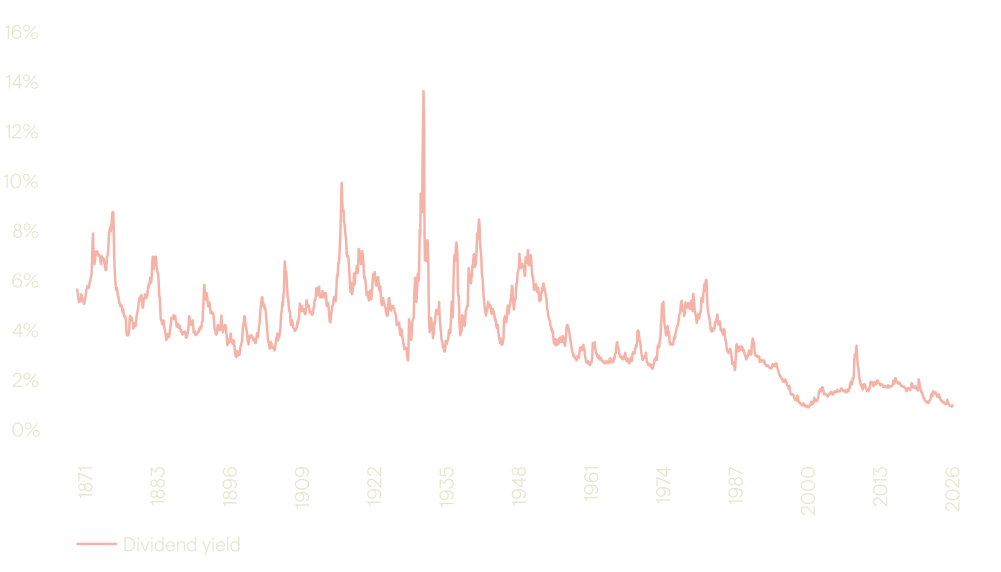
We proxy income with dividends. While many equity investors prefer to focus on earnings, we regard dividends as being less subject to manipulation – these distributions are a tangible payment, and the information is publicly disclosed – and therefore more reflective of the long-term fundamental cash generating properties of the broad market. While other metrics (e.g. free cash flow) have evolved, they do not yet have a similarly long history.
Figure 11: The history of US dividends stretches back over a century
Source: Shiller, U.S. Stock Markets 1871-Present and CAPE Ratio.
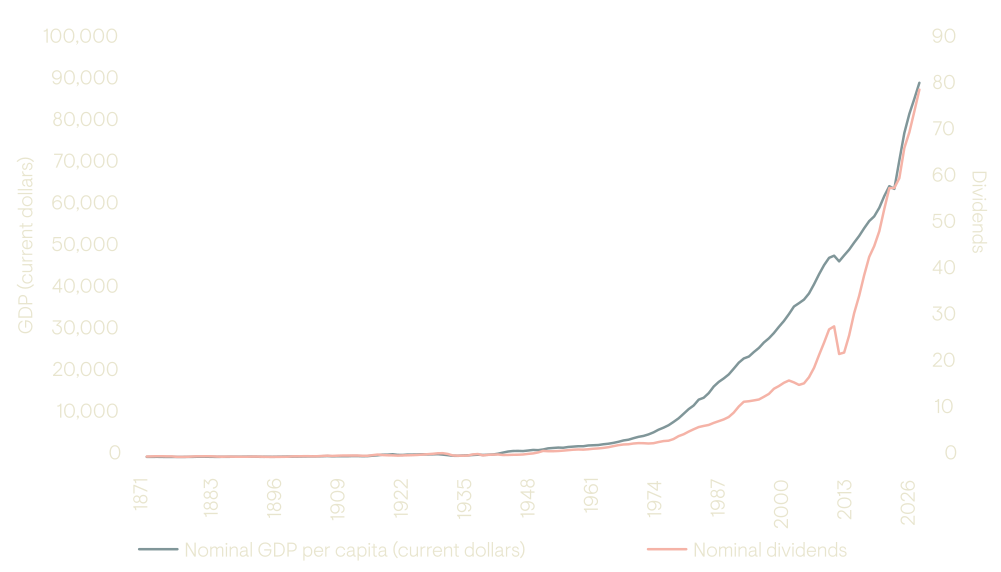
In this context, growth primarily relates to an equity market’s ability to increase dividends over time. GDP per capita has historically proven to be a reasonable proxy for dividend growth – and a closer match than GDP itself, as illustrated in the next chart. We simply allow for the global effects of growth based on the extent of non-domestic revenue exposure, assuming developed market growth is an average of local and global growth, while emerging market growth is wholly determined locally17. Growth is proxied based on trailing 15-year trend growth, a period that captures the secular effects of a couple of cycles. We apply a market adjustment factor – which includes changes in market composition relating to primary and secondary issuance, M&A activity, buybacks, new index inclusions etc. In each case, an owner of the market would have to either inject or remove capital to remain fully invested.
Figure 12: Nominal GDP per capita has proved a useful proxy for dividend growth
Source: Shiller, U.S. Stock Markets 1871-Present and CAPE Ratio; Louis Johnston and Samuel H. Williamson, “What Was the U.S. GDP Then?” MeasuringWorth, 2025.
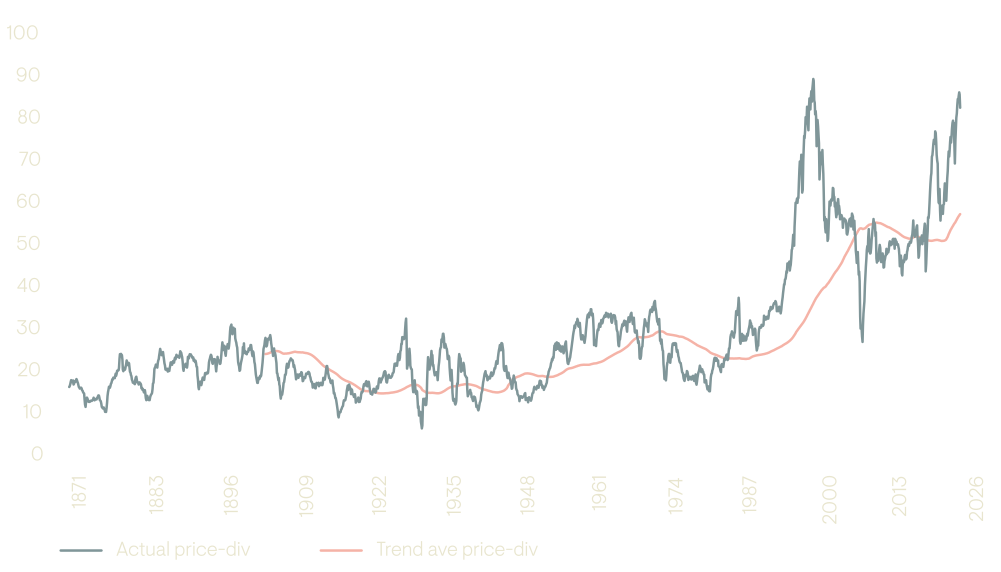
Lastly, we factor in an adjustment for revaluation. We believe that valuation acts as a gravitational pull over long periods; however, changes in market composition and dynamic means that this is not a static metric. We use the price-dividend ratio and trend dividend yield as our valuation metric, assuming this reverts to a long-term (15-year) average. This allows us to both maintain consistency with our income-focused framework and smooth out the cyclical nature of dividends. While we acknowledge full reversion is unlikely – prices tend to overshoot both on the upside and the downside – this simplification remains conceptually sound on average, as can be seen in Figure 13.
Figure 13: The actual price-dividend reverts reasonably neatly to the trend average over time
Source: Shiller, U.S. Stock Markets 1871-Present and CAPE Ratio, internal calculations.
Fixed Income
Our portfolios target specific duration contributions when allocating to bonds; therefore, we feel it appropriate to use constant maturity bonds as the basic building block. We further deconstruct bonds into risk- free and spread components, enabling us to cover both sovereign and corporate debt.
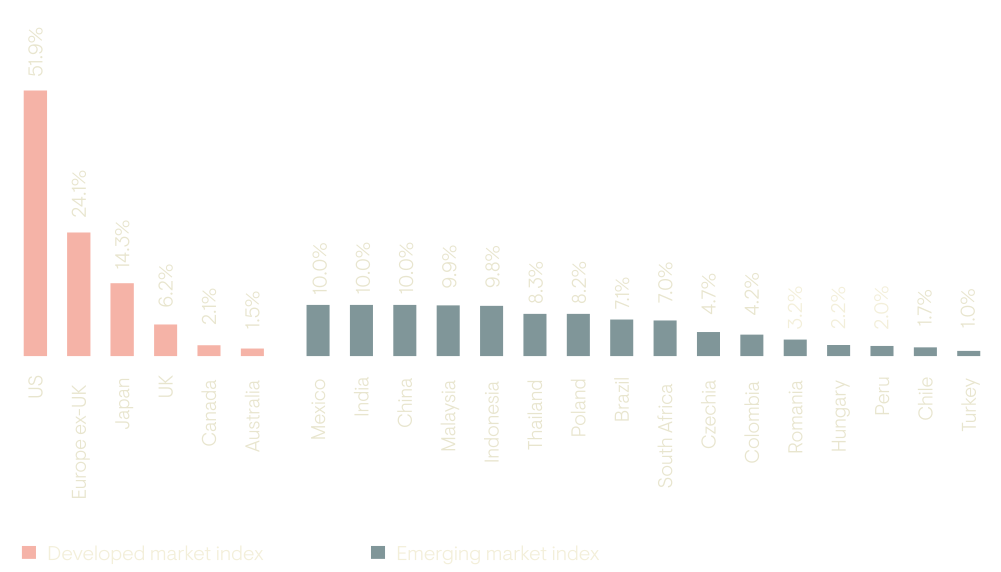
Income assumes the par yield of the bonds, typically for a notional 10-year bond. Regional indices are then generated by using the weighted average of the relevant market inclusions, as illustrated below.
Figure 14: Regional indices are generated using a weighted average of the relevant countries
Source: Ninety One calculations. Weights based on JP Morgan indices.
We define growth as being the roll yield obtained from consistently rebalancing the portfolio to maintain a constant maturity. So, for example, with a typical contango yield curve where the longer-term price is higher than the short-term, after one year the bond holder would sell the lower yielding, higher priced nine-year bond to buy a higher yielding, lower priced 10-year bond. Implicit in this view is a belief that the shape of the yield curve remains relatively consistent (including a constant spread component for credits).
Figure 15: Growth is the roll yield from consistently rebalancing the portfolio to maintain a constant maturity
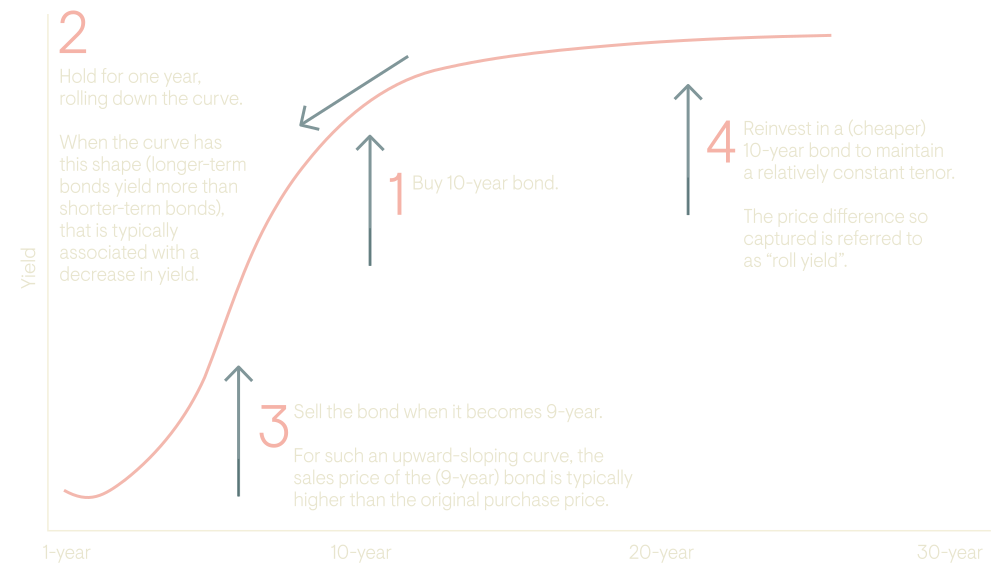
Source: Ninety One. This graphic is for illustrative purposes only.
Revaluation is easier for government bonds than corporates; the former typically have liquid, traded markets enabling us to infer the forward market expectation of pricing. The implicit belief that markets converge to these expectations seems reasonable as a baseline for active management decisions.
Currency
We calculate currency returns in local currency. As explained in the currency section, we then adjust on two bases:
Hedging
Since it is common practice to hedge currency risk, and these costs are largely known at the date of investment, we use this as our base case. We assume that the position is hedged at inception for the 10-year horizon (essentially ignoring the small cash-flow differences that might occur), using covered interest rate parity. We derive the relative hedging cost from the zero-coupon bond yields corresponding to the investment horizon.
Conversion
Many investors are willing to bear the currency risks, and therefore hold their assets unhedged. To proxy this, we use real effective exchange rates – i.e. adjusting the currency cross rates for relative inflation movements. We assume these exchange rates revert to their 15-year averages with an allowance for the difference in inflation targets, thereby allowing some currency mean reversion.
17 Based on the Morgan Stanley Global Exposure Guide 2022, Developed Markets tend to average c. 40% foreign exposure, while Emerging Markets are roughly 25%.
Frequently asked questions
To foster a sense of dialogue, we include a curated list of questions we have received from various stakeholders and our responses. We will continue adding to this section over time.
Q In equities, why have you used GDP per capita and not GDP itself?
GDP per capita has historically proven to be a reasonable proxy for dividend growth.
This is even though the relationship between fundamental company growth, in aggregate, and country-level economic growth is weaker than might otherwise be expected due to compositional mismatches. For example, GDP includes both private and public sector outputs; however, only the former are captured in aggregate via listed equities. Similarly, economic growth tends to be locally focused whereas listed companies often have substantial global operations.
Q What assumptions do you make for credit defaults?
We make allowances for credit defaults with the bond growth rate, using Moody’s long-term default histories. We use the Moody’s country rating for specific country sovereign debt, and the ratings banding for credit indices. By assuming that a AAA rating has similar meaning in both sovereign and corporate contexts, we can reasonably proxy a wide array of indices. (Based on history, we have applied an additional default factor for sub investment grade sovereign debt).
Q Why nominal (and not real) returns?
Inflation is notoriously difficult to predict; so much so, that our work suggested that nominal forecasts were often more reliable than real forecasts.
Q Why two currency bases – hedged and converted?
Both are common approaches to international exposure – some prefer hedging, whereas others are prepared to bear the resultant currency risk. We therefore thought it appropriate to include both so, irrespective of preference, the assumptions would be useful.
Q How are Capital Market Assumptions used within the Multi-Asset process?
Capital Market Assumptions are a framework for thinking about reasonable client outcomes and providing broad market context. These figures do not directly result in individual investment decisions.
Importantly, the Capital Market Assumptions represent the view of the Multi-Asset Capability within Ninety One; other investment teams are free to disagree.
Q Are the assumptions purely systematic?
We wish the framework to be consistent over time to help sharpen thinking on asset-level drivers; therefore, where possible, we prefer to use set assumptions.
We do, however, reserve the right to override specific assumptions where there is a strong market-specific reason to do so.
Q Why do you not predict macro-economic variables within the Capital Market Assumptions?
We wish to understand potential client outcomes over the long-term; therefore, our focus is on identifying those drivers which best explain and predict such outcomes. As can be seen in our framework, that can be done without specific macro-economic views.
Q Why do your growth assumptions look so much more pessimistic than the last twenty years of equity and/or dividend growth?
For corporate cashflows to continue growing at a significantly faster rate than the broad economy, one of three things needs to occur:
- Revenue grows faster than the broad economy – e.g. via the launch of new products which are far superior to competitors, or through the capture of new market segments. The former should not make a difference at the aggregate market level (one competitors revenue growth comes at the expense of another) but the latter may occur through, for example, internationalisation. That is why we link growth to a mixture of local plus global GDP.
- Costs fall (or, equivalently, margins increase) – e.g. via lower tax rates, more efficient use of resources, economies of scale, or regulatory capture. We think further margin expansion is challenging as tax decreases have likely reached their nadir, while regulatory capture cannot happen indefinitely. Since we have not yet found a reasonable long-term (10-year) predictive proxy, we prefer not to forecast this element, i.e. assuming that margins remain roughly constant.
- Business reinvestment increases (when returns are higher than the cost of capital) – If businesses are prioritising their investment, marginal investments will offer a decreasing rate of return, such that ultimately returns converge to cost of capital. If not, we’d expect competitors to enter. Again, a natural limit exists. Again, in the absence of a reliable predictive proxy, we essentially assume that pay-out ratios remain constant.
In short – because we focus on variables that have both been historically predictive and have a sensible fundamental interpretation, we continue to favour GDP as a predictor (implicitly, of revenue). We continue to actively research appropriate variables for margins and pay-out ratios; however, in an environment where we think each faces headwinds, we are comfortable to continue with our simplifying assumption.
Q How often are your assumptions updated?
We intend to update the Capital Market Assumptions twice each year – after the March and September quarter-ends.
We may also provide intra-period updates if we believe a market event is significant enough to materially change the 10-year outlook. For example, we released an internal update in late March 2020 to highlight the potential upside from equities and credit after the initial COVID-induced market collapse.
Q What is an index divisor and what causes this value to change?
The index divisor is defined as:
Index divisor = Index market cap/Index price
The index divisor is central to the calculation of equity indices because there are corporate actions and compositional changes which affect the aggregate value or market capitalisation measured by the index, but which do not impact the performance of the index. When the market value of the index increases or decreases because of one of these events, the index divisor is adjusted to ensure that the price of the index remains unchanged.
The impact of specific corporate actions or compositional changes can be either positive or negative for future returns, but they are aggregated into a single overall value.
A non-exhaustive list of some of the corporate actions which impact the index divisor is given in the table below.
| Corporate action | Impact on index divisor | Impact on index returns |
|---|---|---|
| Share repurchase (buyback) | Negative | Positive |
| Rights issue | Positive | Negative |
| Stock-based compensation | Positive | Negative |
| IPO | Positive | Negative |
| Cash acquisition (of index constituent) | Negative | Positive |
| Spin-off (where spin co is not an index constituent) | Negative | Positive |
In addition, the composition of the index can change as a result of index rebalancing events where index rules determine that existing companies be added to or removed from an index or that the proportion of a company’s shares which are included in the index changes. For regional indices, whole countries may also be added or removed from the index.
Items such as buybacks tend to be stable – their attractiveness is based on the regulatory and taxation basis applicable at a point in time, which tend to change infrequently. Other sources may be more volatile – for example, market changes due to M&A activity, views on the appropriateness of stock-based compensation, or even secondary issuance due to market stress. We infer the market adjustment impact from the change in MSCI Index Divisor over time.
Q Have you considered the impact of issuance or other corporate activity on the growth of income within equities?
Broad economic growth drives the growth generated by the listed corporate sector over the long run. However, it is accepted that corporate action, including mergers, acquisitions, research, and innovation ensure that the corporate sector is dynamic, undergoing compositional changes over time.
Our process starts with an assessment of the aggregate growth of the dividends paid by this dynamic mix of businesses. The next step is to make a market adjustment to capture all the corporate actions and index composition changes which directly increase or decrease the total value of equity measured by the market index.
As defined, the market adjustment factor is important as it changes the participation in the aggregate dividend growth of the entire market for an ongoing investor in the index. Market adjustments at the index level are analogous to but not identical to the way that equity issuance and repurchases affect returns for a single stock. To understand this, we must first recognise that to receive the index return, an investor must build a portfolio which holds every stock in the index in their index weights and which adjusts these holdings over time as index composition and weights change.
Any corporate action or index composition change which adds new equity capital into the index therefore dilutes future index returns in the same way that a company making a rights issue dilutes returns for holders of that stock. In both cases, if an investor does nothing, their ownership of the index or of the stock declines and the proportion of future value creation which flows to their shares falls. On the flipside, any corporate action or index composition change which removes equity capital from the index is accretive to future returns in the same way that a company repurchasing and retiring existing shares is accretive.
Importantly, these effects only directly impact an investor who seeks to own the entire market as defined by the index provider. For an active investor who does not hold the companies which launch these corporate actions there is no direct impact on their returns although there may be indirect impacts because of related capital flows or changes in the competitive environment.
Q How effective have your Capital Market Assumptions been?
As can be seen in this analysis, the Capital Market Assumptions have shown clear differences between market troughs and market peaks.
Q Given that Capital Markets Assumptions have so much associated uncertainty, what is the benefit of even attempting?
We see two key benefits:
- A clear understanding of return drivers enables sharper thinking about potential asset class outcomes, including under various scenarios.
- Insight into the likely direction and possible magnitude of returns helps our clients understand what outcomes may be reasonable.
Q Why use dividends/price-dividend rather than earnings and the more conventional price/earnings?
Dividends, being physical payments to shareholders, are less subject to manipulation than earnings (which are only book profits). We believe that results in stronger conclusions.
In addition, data sets tend to have a longer history of dividend payments, enabling us to consider the approach in a broader variety of historic contexts.
Q What key factors are not considered in your approach?
Our Capital Market Assumptions assume that the fundamental market drivers remain unchanged. They therefore ignore exogenous shocks – e.g. climate risks and geopolitical events (although we may update our assumptions in the event of a material shock).
We currently focus on single-asset return outcomes; therefore, we make no comment about potential changes in cross-asset correlations or asset-specific volatilities.We do not adjust for individual client circumstances either: client tax status may impact the relative attractiveness of asset classes.
Q Why a 10-year horizon?
As long-term custodians of our client’s capital, our focus is on helping our clients achieve suitable outcomes.
In addition, we require a timeframe long enough for fundamental drivers to be expressed, despite cyclical noise.
Ask a question
If you have any questions about our framework that you'd like to discuss further, please complete this form and we will respond to you directly
General risks. Forecasts are inherently limited and modelling involves risks, assumptions and uncertainties, they are forward looking and are not guarantees nor a reliable indicator of future results. Actual returns could be materially higher or lower than projected. This information is not intended as a recommendation to invest in any particular asset class or strategy or as a promise of future performance. The value of investments, and any income generated from them, can fall as well as rise. Costs and charges will reduce the current and future value of investments. Where charges are taken from capital, this may constrain future growth. Past performance is not a reliable indicator of future results. If any currency differs from the investor's home currency, returns may increase or decrease as a result of currency fluctuations. Investment objectives and performance targets are subject to change and may not necessarily be achieved, losses may be made. Environmental, social or governance related risk events or factors, if they occur, could cause a negative impact on the value of investments.
Explore more insights

Insights
Market and portfolio insights, webinars & events curated from across our investment teams to help you steer through changing investment landscapes.
Important information
Source: Ninety One proprietary capital market assumptions as at 31 March 2026.
These estimates are gross of fees (returns can be reduced by management fees and other expenses incurred) and reflect the view of Ninety One’s multi-asset team, whilst the views of other teams across Ninety One may differ. Details on our Capital Market Assumptions methodology available upon request.
Our expected returns estimates are for illustrative purposes only, are not a guarantee of performance and are subject to change. They are provided merely as a framework to assist in the implementation of an investor’s own analysis and an investor’s own view on the topic discussed herein. They should not be relied upon as recommendations to buy or sell securities. Forecasts of financial market trends that are based on current market conditions constitute our judgment and are subject to change without notice. We believe the information provided here is reliable, but do not warrant its accuracy or completeness. The outputs of the assumptions are provided for illustration/discussion purposes only and are subject to significant limitations. Expected return estimates are subject to uncertainty and error. Expected returns for each asset class are conditional on an economic scenario; actual returns in the event the scenario comes to pass could be higher or lower, as they have been in the past, so an investor should not expect to achieve returns similar to the outputs shown herein. Because of the inherent limitations of all models, potential investors should not rely exclusively on the model when making a decision. Unlike actual portfolio outcomes, the model outcomes do not reflect actual trading, liquidity constraints, fees, expenses, taxes and other factors that could impact the future returns. Note that these asset class assumptions are passive, and do not consider the impact of active management. All estimates in this document are in US dollar terms unless noted otherwise. The final total returns are converted from logarithmic to geometric estimates. This means that the components of the return breakdown may not sum to the total return. While useful for modelling and calculation purposes, the logarithmic return is theoretical (assumes continuously compounding returns) whereas the geometric estimate reflects practical experience (reflects discrete periods of compounded returns).
Indices
Indices are shown for illustrative purposes only, are unmanaged and do not take into account market conditions or the costs associated with investing. Further, the manager’s strategy may deploy investment techniques and instruments not used to generate Index performance. For this reason, the performance of the manager and the Indices are not directly comparable.
If applicable MSCI data is sourced from MSCI Inc. MSCI makes no express or implied warranties or representations and shall have no liability whatsoever with respect to any MSCI data contained herein. The MSCI data may not be further redistributed or used as a basis for other indices or any securities or financial products. This report is not approved, endorsed, reviewed or produced by MSCI. None of the MSCI data is intended to constitute investment advice or a recommendation to make (or refrain from making) any kind of investment decision and may not be relied on as such.
If applicable FTSE data is sourced from FTSE International Limited (‘FTSE’) © FTSE 2026. Please note a disclaimer applies to FTSE data and can be found at here.
Global equities = MSCI All Countries World; Developed equities = MSCI World; US equities = MSCI USA; Continental Europe equities = MSCI Europe ex UK; Japan equities = MSCI Japan; UK equities = MSCI UK; Emerging equities = MSCI EM; China equities = MSCI China; Global sovereign bonds = Country-weighted composites, based on the JP Morgan Global Bond Index, of our regional estimates*; US, Europe, Japan, UK, China sovereign bonds = Notional 10-year bond; Emerging (Local Currency) bonds = Country-weighted composites, based on the JP Morgan GBI-EM Global Diversified, of our regional estimates*; US Investment Grade = Notional 10-year bond, using Bloomberg US IG Yield Curve; US High Yield = Notional 5-year bond, using ICE BAML US High Yield index for OAS; Sovereign Emerging (Hard Currency) = Notional 10-year bond using JP Morgan EMBI Global Diversified Index spread; Emerging Investment Grade = Notional 5-year bond using JP Morgan CEMBI Global Diversified Index spread.
*Not all of which are shown here.