Global Outlook
Philip and Sahil share their thoughts on the outlook for 2026 and where investors should position for the next cycle.
The fast view
- Macro: Investors should position for a goldilocks macro backdrop, with above-trend growth, mild disinflation (despite higher-than-target rates) and risks to the upside. It adds up to a relatively benign outlook for cross-asset returns.
- AI: The risks of an AI crash or super-bubble appear to be waning. More likely is a necessary but modest correction that reprices risk and resets the economics of providing AI services.
- Geopolitics: The risks between the major powers likely peaked in 2025, with the US and China entering a new era of détente. But relations between China and the EU could come under further strain.
- Currencies: The structural forces underpinning US dollar strength are turning – this is a year to sell dollar rallies, not chase them. Narrowing rate differentials and reduced geopolitical risk offer potential in select ex-US currencies, notably in emerging markets.
- Developed markets equities: Global earnings remain solid, but valuations and concentration risk argue for rebalancing. Equity market performance should broaden to include more cyclical, value and rate-sensitive equities. We expect international markets to outperform US markets.
- Emerging markets equities: The global backdrop is supportive for EM equities, especially if we see a material US-dollar downtrend, while net-issuance headwinds have faded. To mitigate a key risk, we favour balancing exposure between AI and non-AI segments.
- Developed markets bonds: Developed bond markets currently offer reasonable value, and at these valuations are likely to play diversifying roles in portfolios once more. With central banks maintaining a pro-recovery stance, we expect modest steepening: yield declines for shorter-dated bonds but a ‘sticky’ long end of the curve.
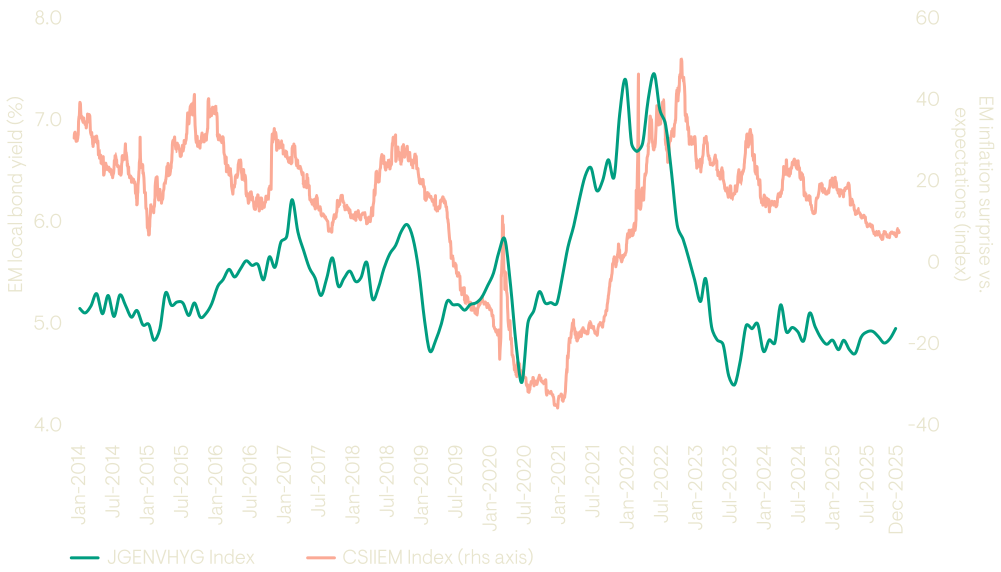
- Emerging markets bonds: Disinflation, high real policy rates and still-light foreign positioning create a constructive backdrop for local bonds. Hard-currency debt continues to offer competitive carry.
- Credit: Public credit should stay resilient amid firmer growth, but more mainstream private credit markets will continue to be strained by leverage. A focus on quality issuance and specialist areas such as structured credit is appropriate. In private markets, less crowded markets such as EM, offer a favourable risk profile.
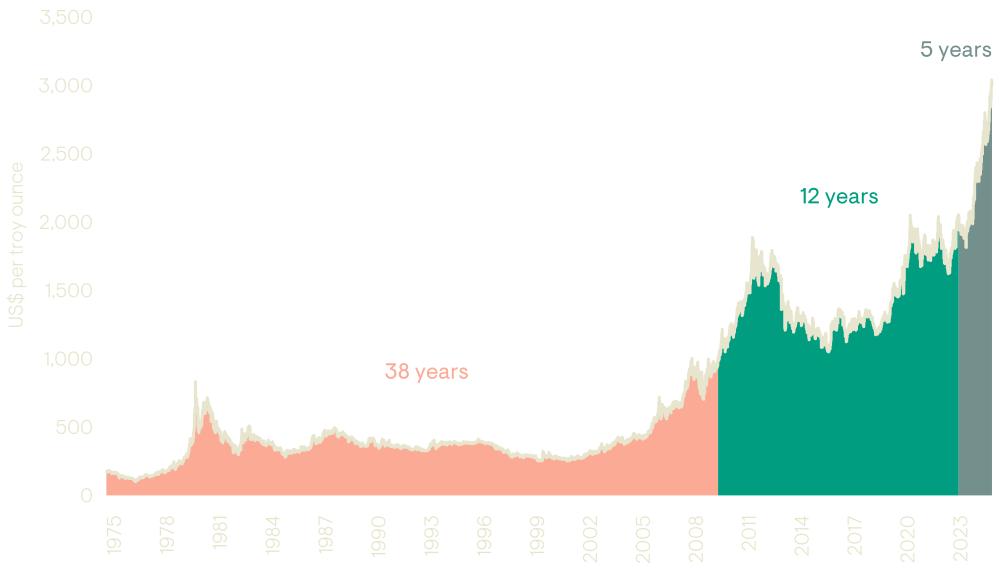
- Commodities: Gold’s structural bull market persists. Copper should benefit from tight supply and robust demand, while mining and energy equities offer attractive valuations and diversification potential.
Chapters
Macro
Are markets early, mid or late cycle? It is surprisingly difficult to answer. Labour markets appear soft and credit spreads are tight, a classic late-cycle dynamic of high expectations and weakening data. On the other hand, accelerating capital expenditure on equipment and intellectual property, along with falling inventory-to-sales ratios, imply early-cycle dynamics of economic stabilisation and renewed growth. It is possible to say markets are undergoing a series of rolling recessions, or the opposite: markets are undergoing a series of rolling recoveries.
How did we end up in this disaggregated, idiosyncratic cycle? For a series of interlocking reasons, 2022 did not trigger the typical reset expected from sharp, sustained interest-rate hikes in response to an inflation shock.
- Fiscal policy remained loose in many economies, strengthening already healthy private-sector balance sheets with long debt lock-ins. This underpinned an income-driven, as opposed to credit-driven, spending dynamic.
- Buoyant asset prices and highly unequal ‘K-shaped’ asset holdings (wealthier households holding the majority of assets have benefitted most from rising markets) have kept consumption elevated.
- The labour market responded to interest-rate hikes in unusual ways, adjusting from 2022–2024 through fewer vacancies rather than big layoffs, as employers hoarded workers after their experiences with pandemic staff shortages.
- Following the rate hikes, from H2 2023 onward advanced economies have undergone a second wave of tightening via term-premia increases in long rates. This extra-volatile tightening pathway does not map neatly onto textbook rate-hiking phases.
- The unpredictable nature of the US–China decoupling, including recent tariffs – in the context of an historic Chinese property tightening cycle – has increasingly rendered the notion of a single global cycle misleading.
- Rolling energy shocks have disrupted various supply chains, not least after the Russian invasion of Ukraine in 2022.
- The gargantuan ramp-up of AI spending has occurred despite global central banks holding monetary policy at restrictive levels.
For investors, establishing a realistic macro picture requires reorientation to a new environment. It also means temporarily moving away from the idea of a cycle altogether. A cycle implies recurrence, regularity and repetition. What we are going through is more idiosyncratic and chaotic.
To an extent, of course, every cycle is idiosyncratic. The word ‘cycle’ is really just a shorthand for describing broad phases – expansions, peaks, contractions and troughs – as a complex system reconfigures via a series of shocks. But the past year has been more disorienting than usual for those looking for overarching patterns. So rather than thinking in cyclical phases, we think the key is to disaggregate the macro building blocks and realign them into a narrative that makes sense for the circumstances we find ourselves in.
The key call for 2026
The main call investors have to make for 2026 – the cornerstone building block – is whether growth or inflation will be the dominant market driver over the next 12-18 months. When growth dominates, equities correlate negatively with bonds. When inflation dominates, equities and bonds are often positively correlated.
In our view, growth will be more important than inflation in 2026, underpinning a relatively benign environment for cross-asset returns. For the past six months, global policy easing has been feeding through into monetary and credit data, supporting a recovery. At first, the improvement was more visible ex-US; more recently US data has also picked up, with growth momentum improving across the board. Meanwhile, inflation has been relatively well-behaved, helping sustain the easing backdrop.
Figure 1: Improving growth momentum
Economic Surprise Indices
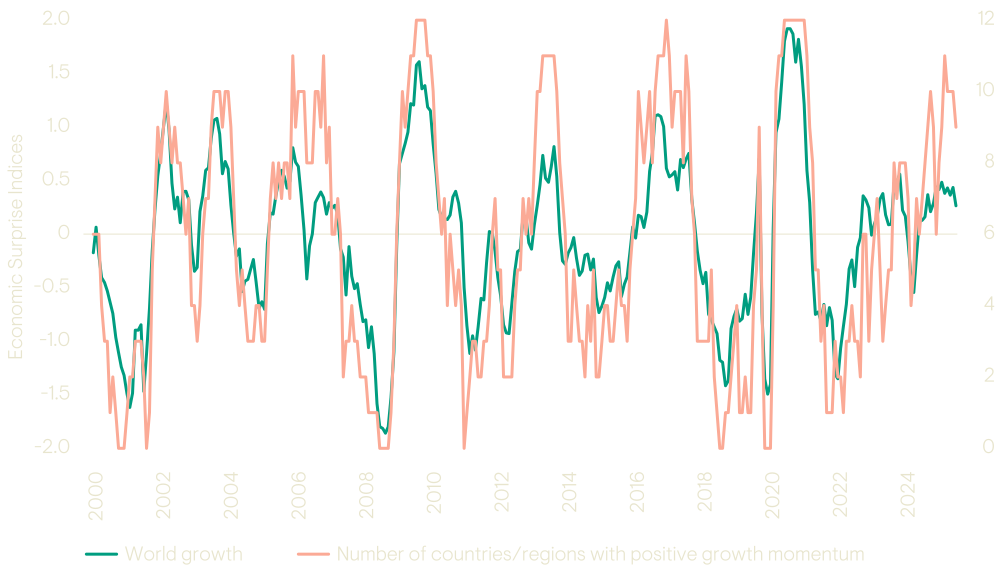
Figure 1: Source: Bloomberg, Citigroup, November 2025.
Inflation more likely to undershoot
For most of this year, inflation is more likely to surprise on the downside than the upside. Even if it remains above target in advanced economies, and will almost certainly rise somewhat in H1 on base effects, stimulative policy and continued tariff pass-through, we expect it to end the year somewhere around 2% in the US and eurozone.
In the US, the Personal Consumption Expenditures (PCE) price index has a reasonable shot at meeting consensus and reaching 2.5% year-on-year by Q4 2026. If the big, slow-moving component of shelter (a 15-18% weight in the PCE and 33-36% in the Consumer Price Index (CPI)) continues to disinflate and new leases to rise at only about 2%, shelter’s contribution to CPI and PCE will mechanically fall further in 2026. While the US fiscal stance is set to ease sharply early in 2026, in part through one-off fiscal refunds early this year, it will be in tightening mode for the rest of the year. Meanwhile, the inflation impact of tariffs on prices is likely to materially fade by the end of the year as households absorb costs, and importers shift sourcing to blunt tariff impacts (e.g., China’s share of US goods imports is already falling, and is now under 10%). There is potential upside risk were the administration to pursue a further fiscal boost via stimulus cheques.
In Europe, a larger fiscal impulse led by Germany is expected to build in 2026/2027, which risks slowing or stalling disinflation in the context of sticky inflation. Nevertheless, CPI is likely to end the year at or around 2%. China is an outlier in the sense that its GDP deflator has been negative for 10 straight quarters, underpinning a disinflationary global impulse. While Chinese real growth is holding up and 2026 forecasts are set to be revised upwards, PPI is still likely to be in deflation by year-end and CPI comfortably below 1%. Emerging markets inflation, particularly in Asia, is muted and likely to remain so in 2026.
Growth will run above trend
Growth is the next macro building block investors have to make a call on. In our view, global growth will run above trend in 2026, at >3% in real terms. Currently, economies are still benefitting from policy easing in 2025. The rough rule of thumb is that monetary policy leads growth and inflation by 12-24 months, with easing impacting growth sooner than inflation. The lags can be longer or shorter, depending on the economic cycle and region. For instance, the transmission mechanism has historically been shorter in the EU and the UK, primarily due to the structure of mortgage markets.
Fiscal support in the US will see the GDP impact of the One Big Beautiful Bill (OBBB) peaking in Q3 2026, just before the midterm elections. The relatively blunt IMF US fiscal impulse metric (a measure of the impact of discretionary changes in fiscal policy) for 2026 indicates a contraction of 0.3 percentage points due to tariffs. In contrast, a more granular fiscal impulse metric from Brookings shows that US fiscal policy is likely to be stimulative in 2026, especially in H1, as a result of the OBBB. There is even upside fiscal risk as a response to the affordability crisis – and the partly consequent poor performance of the Republicans in gubernatorial and state votes in November 2025 – for instance via the US$2,000 tariff-dividend cheques the Trump administration has discussed. To the extent that the Supreme Court reassess the legal basis of President Trump’s tariffs (specifically, his use of the International Emergency Economic Powers Act), things could get messy, especially with the refund process. However, we believe the US administration would ultimately be able to recreate most of the tariff policies under different legal bases. While average tariff rates may move down a few percentage points, the big picture is that they will still be multiples of what they were at end-2024.
In the eurozone, fiscal policy will add 0.2 percentage points to GDP for 2026 and another 0.2 percentage points for 2027. Germany is the epicentre of the fiscal shift, with the amendment to the famous debt-break (Schuldenbremse) propelling defence and infrastructure spending to add 1 percentage point to GDP for 2026 and also for 2027. Japan’s fiscal impulse will be 0.5 percentage points in 2026, on account of the planned stimulus to jumpstart the economy from new Prime Minister Sanae Takaichi’s government. China’s fiscal impulse is likely to be flat.
The global credit impulse has turned modestly positive, a classic lead indicator for firmer nominal growth activity. This is particularly true for the US, where credit growth is now accelerating. As rate cuts continue to exert an easing effect on the economy, the rate-sensitive (and currently weak) segments should begin to improve, while the strong segments may cool but seem unlikely to fall off a cliff, yielding a broader, more robust recovery.
Risks to the growth outlook
There are obviously risks to our growth outlook. While our base case is that labour markets remain tight while loosening at the margin, there is the possibility of a more disorderly outcome. We are in a low-hire/low-fire economy, and the US unemployment rate is rising (the eurozone unemployment rate continues to fall). Consumption over the last few years has been supported by tight labour markets, with strong balance sheets in the US and high savings in Europe. Indeed, continued household deleveraging has pushed household debt-service payments as a share of disposable income to the lowest level since the late 1990s in the US and elsewhere. All that is at risk if labour markets start to weaken.
Figure 2: Households are deleveraging
Household debt service ratios
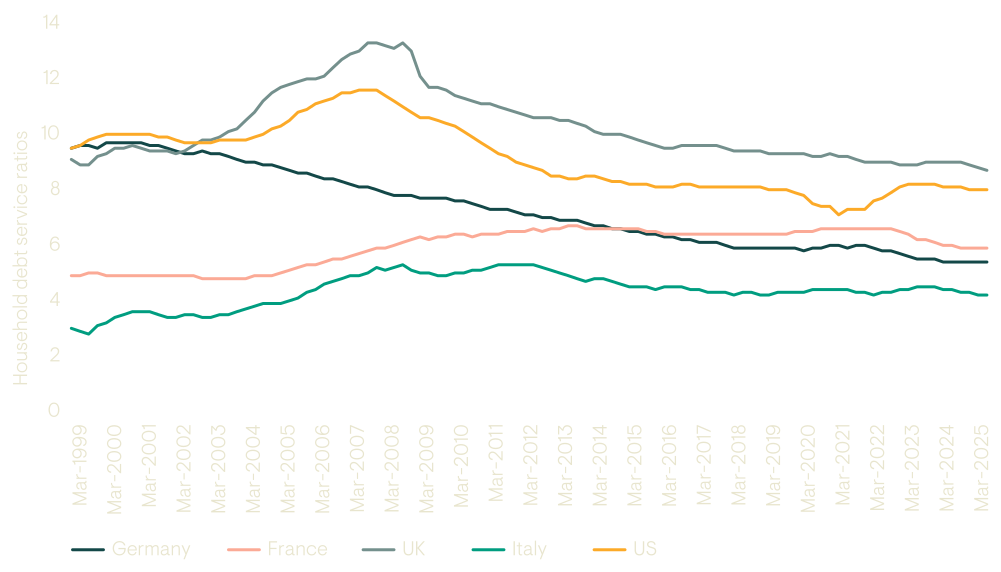
Source: Bloomberg, June 2025.
AI poses two-way risks
There is also a small but growing possibility of a negative growth impulse from a reassessment of AI investment. Unlike in the late 2000s when widespread leverage helped cause a debt-fuelled bubble in subprime housing, today’s AI spending has been mostly equity-financed. In that sense, the AI boom is closer to 1999 than 2009. Nevertheless, the longer the boom goes on, the more it is likely to involve debt and opacity. Meanwhile, US consumers are more financialised than they were in the late 1990s, with more of them in the market and increasingly spending gains from asset-price appreciation. While US private balance sheets are healthy, the share of US household assets in equities is now 21%, vs. the 17% peak in 2000. Also, foreign investors are more invested in US stocks, where gains have been highly concentrated in the AI theme. IMF chief economist Gita Gopinath’s back-of-an-envelope estimates suggest that a crash of the same magnitude as dotcom could wipe out US$35 trillion of global financial wealth. The longer the boom goes on, the lower the bar is for a bigger correction.
Of course, AI also poses upside risks to growth. The technology is being adopted rapidly and could substantially accelerate innovation and automation across sectors, as well as boosting labour productivity. While economists are sceptical that AI is having much impact on labour markets, businesses are telling a different story. AI labour productivity estimates for the next decade range from 0.2 – 1.3 percentage points annually, depending on the country. However, AI’s impact on markets depends on whether it contributes to higher revenues or merely lower costs. If the latter, it would keep the economy weaker than expected; if the former, it could contribute to the goldilocks outcome of boosting growth and keeping inflation low as early as this year. Both scenarios would be visible in profit margins.
Policy evolution
The next building block: how is central-bank policy likely to evolve in 2026? At the most basic level, central banks have to judge whether they are more concerned about unemployment or inflation. For 2026, we think the US Federal Reserve (Fed) is still in a world where it is more concerned about disorderly labour markets than accelerating price rises.
One reason for this is that central banks are now increasingly mindful of growing political risk, as seen in the politicisation of Fed appointments recently. Independent central banks know they have one job, which is to keep inflation under control, and will therefore use their powers to push back on political interference. Nevertheless, they are fully aware of the stakes for their institutions, and on balance that is likely to raise the bar for adopting a tightening/hawkish stance. We do not think the choice will come to a head in 2026 because inflation is likely to stay muted.
Currency currents
As is so often the case in macro analysis, the expression of the environment is most easily seen in the performance of foreign exchange, another key macro building block. We think the US dollar passed a significant inflection point in early 2025, entering a multi-year downcycle for reasons we have set out elsewhere. This year, we see an environment for selling US dollar rallies, rather than chasing them. It is true that, while inflation remains above target, the room for Fed easing is capped and any further bouts of US exceptionalism would keep the US dollar firmer. On the other hand, a stumble in the AI trade in the context of large fiscal and external deficits would send the dollar sharply lower. In any scenario, foreign portfolios are likely to hedge more of their US equity exposure after their experience in April 2025, when President Trump’s new tariff policies rocked markets.
Figure 3: Rate differentials have narrowed
Difference in 2-year yields
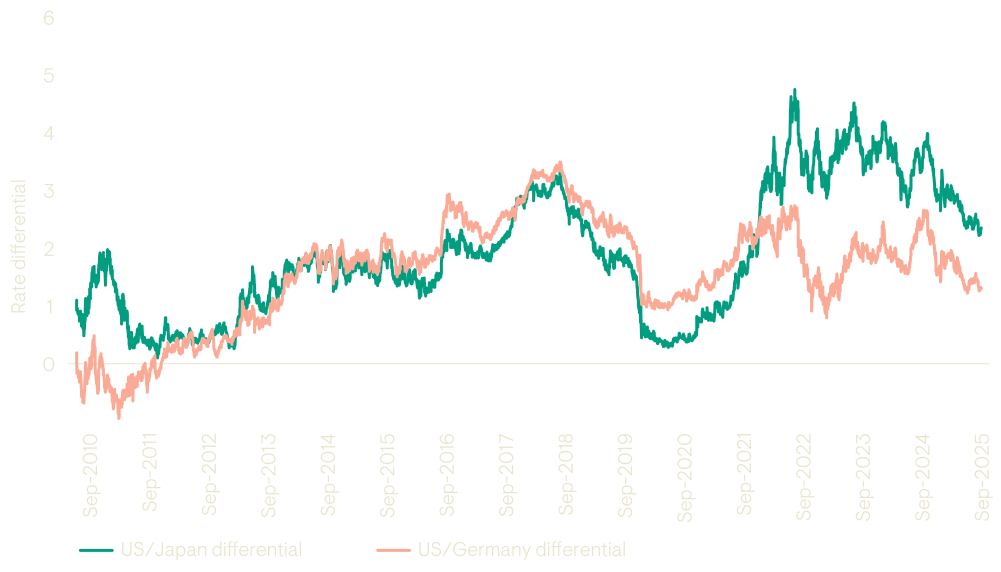
Source: Bloomberg, December 2025. Charts shows 2-year yield, 3m forward.
Non-US currencies, including those of emerging markets, are likely beneficiaries of much lower interest differentials between the euro and the US dollar, and the Japanese yen and the US dollar, which is likely to contain dollar appreciation. Indeed, despite US data rebounding in 2025, it is notable that rate differentials have continued to narrow. Dollar weakness could benefit emerging markets particularly, decisively reversing the situation of the 2010s when developing economies were stuck between the Scylla of a rising US dollar and the Charybdis of a weak yen and euro, which reduces liquidity and deflates the global economy.
Figure 4: The US dollar is above its long-term average
US dollar index

Source: Bloomberg, July 2025.
Summary: still goldilocks, but risks are two-way
In sum: given the health of private-sector balance sheets and an easing Fed, one might expect a classic reflation. However, due to the competing cross-currents in the economy, we might see something a bit more subdued but still quite healthy: firm real growth with inflation surprising lower for most of the year. There could be reflation-like flashes early in the year due to tariff pass-throughs, but the year-end destination is likely more moderate, with inflation ending close to target. Downsides to our view are a disorderly labour-market weakening and an AI-driven market correction (see ‘AI outlook’). There is an upside case of AI-driven productivity gains, but it requires a specific evolution of AI productivity gains, one that favours higher revenues and not merely lower costs.
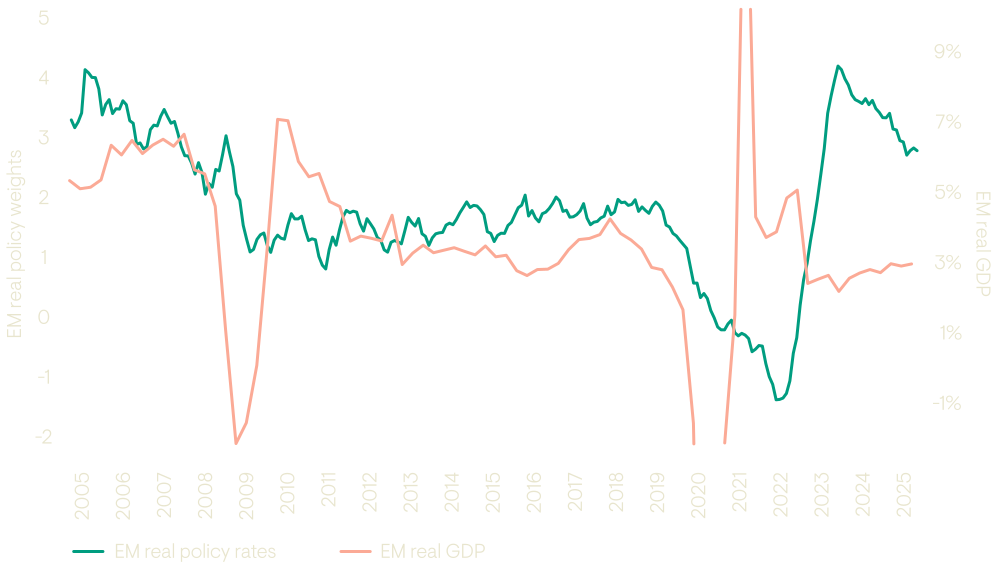
For a deep-dive on the outlook for developing economies, please see our Emerging Markets Outlook.
General risks. All investments carry the risk of capital loss. The value of investments, and any income generated from them, can fall as well as rise and will be affected by changes in interest rates, currency fluctuations, general market conditions and other political, social and economic developments, as well as by specific matters relating to the assets in which the investment strategy invests. If any currency differs from the investor’s home currency, returns may increase or decrease as a result of currency fluctuations. Past performance is not a reliable indicator of future results. Environmental, social or governance-related risk events or factors, if they occur, could cause a negative impact on the value of investments. No representation is being made that any investment will or is likely to achieve profits or losses similar to those achieved in the past, or that significant losses will be avoided. Individual companies or securities named in this material are included for illustrative purposes only.
Specific risks. Commodity-related investment: Commodity prices can be extremely volatile and significant losses may be made. Currency exchange: Changes in the relative values of different currencies may adversely affect the value of investments and any related income. Interest rate: The value of fixed income investments (e.g. bonds) tends to decrease when interest rates rise. Default: There is a risk that the issuers of fixed income investments (e.g. bonds) may not be able to meet interest payments or repay the money they have borrowed. The worse the credit quality of the issuer, the greater the risk of default and therefore investment loss. Emerging market: These markets carry a higher risk of financial loss than more developed markets as they may have less developed legal, political, economic or other systems. Equity investment: The value of equities (e.g. shares) and equity-related investments may vary according to company profits and future prospects as well as more general market factors. In the event of a company default (e.g. insolvency), the owners of their equity rank last in terms of any financial payment from that company.
Authored by
2026 Outlook