A new phase of European bank retrenchment
Over the last decade, Europe’s banking sector has undergone profound transformation. Since 2009, the number of EU credit institutions has shrunk by over 38%. Successive regulatory regimes – first Basel III and more recently national regulatory interventions such as those by Switzerland’s FINMA – have reshaped capital allocation frameworks, making banks structurally less able and less willing to support mid-market borrowers.
The number of EU credit institutions has fallen by more than 38% since 2009
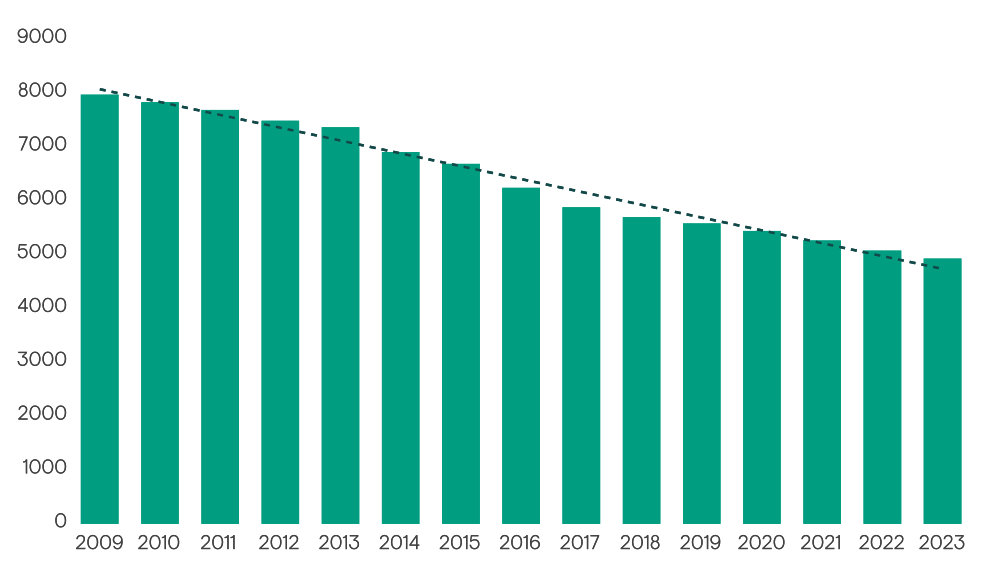
Source: European Banking Federation – Banking in Europe: EBF Facts & Figures 2024. Dots denote trend line.
While headline non-performing loan (NPL) ratios remain low by historical standards, there are signs that they are beginning to edge higher. The fourth quarter of 2024 saw marked increases in corporate NPLs in Austria, Germany and the Netherlands, with Austria’s corporate NPL ratio jumping by 53 basis points1. Rising stress in the real estate and manufacturing sectors – together representing c.40% of aggregate corporate loan exposures – signals that pressure is building2.
EU Banks - NPL ratios by country
| Country | Dec-20 | Dec-21 | Dec-22 | Dec-23 | Mar-24 | Jun-24 | Sep-24 | Dec-24 |
|---|---|---|---|---|---|---|---|---|
| Austria | 2.1 | 1.9 | 1.8 | 2.2 | 2.2 | 2.2 | 2.3 | 2.4 |
| Germany | 1.3 | 1.1 | 1.1 | 1.3 | 1.3 | 1.4 | 1.5 | 1.6 |
| Denmark | 2.0 | 1.5 | 1.4 | 1.4 | 1.4 | 1.4 | 1.4 | 1.5 |
| Sweden | 0.5 | 0.3 | 0.2 | 0.3 | 0.3 | 0.3 | 0.4 | 0.4 |
| The Netherlands | 1.9 | 1.7 | 1.4 | 1.3 | 1.3 | 1.2 | 1.2 | 1.3 |
| Belgium | 2.0 | 1.5 | 1.5 | 1.2 | 1.2 | 1.2 | 1.3 | 1.3 |
| Finland | 1.5 | 1.3 | 0.9 | 1.1 | 1.2 | 1.1 | 1.2 | 1.2 |
| France | 2.2 | 1.9 | 1.9 | 1.9 | 2.0 | 2.0 | 2.1 | 2.0 |
| Italy | 4.1 | 3.1 | 2.5 | 2.4 | 2.4 | 2.4 | 2.4 | 2.3 |
| Spain | 2.9 | 3.1 | 2.8 | 2.8 | 2.9 | 2.8 | 2.8 | 2.7 |
| EU | 2.6 | 2.0 | 1.8 | 1.8 | 1.9 | 1.9 | 1.9 | 1.9 |
Source: Scope Group, Scope Ratings EU Banks: NPL Heatmaps Q4 2024.
While aggregate NPL ratios across Europe have remained stable recently, macroeconomic developments, including escalating trade tensions and geopolitical risks, increase the likelihood of further deterioration.
Increased rates of NPLs only add to the bank retrenchment dynamic. As banks’ credit committees become heavily pre-occupied with managing existing exposures and dealing with NPLs, their capacity to underwrite new loans – particularly for anything non-standard – is likely to be squeezed.
Crucially, these pressures aren’t just cyclical. As we have highlighted, the banks are already retrenching. But the cyclical dynamics exacerbate the point, with headwinds from tighter regulatory capital requirements, increased risk aversion, and ongoing supervisory scrutiny all pushing institutions further toward risk-off behaviour. For context, the European Central Bank’s euro area bank lending survey revealed a 3% net tightening of credit standards for loans or credit lines to enterprises in the first quarter of 2025. This followed a similar trend reported in Q4 2024, and again was driven by higher perceived risks related to general economic and firm-specific outlooks. For the second quarter of 2025, banks expect a further net tightening (5%) of credit standards for loans to firms.3
A structural funding gap for small and medium enterprises
The clearest consequence of this trend is a significant and persistent funding shortfall for Europe’s SMEs. As of mid-2024, the SME funding gap was estimated at €930 billion2. The European Central Bank’s Q1 2025 bank-lending survey underlined that access to credit for SMEs continues to deteriorate, with higher rejection rates and increased borrower discouragement – especially when compared to large corporates.
For Europe’s mid-market, non-sponsored borrowers – typically entrepreneur- or family-owned businesses not backed by private equity – this creates a fundamental mismatch: demand for capital is rising, while bank supply is falling. These businesses are often capital-efficient, profitable, and asset-rich, but unable to access credit due to size, complexity, or the absence of a sponsor.
This growing dislocation presents a compelling opportunity for specialist private credit managers focused on directly originating non-sponsored borrowers. These lenders are not just alternative capital providers; they are enablers of growth for businesses that are otherwise underbanked.
Keys to successful investment outcomes
For investors operating in this field, we believe the following considerations are key to ensure the optimal combination of compelling returns and downside management:
1. A focus on underserved but creditworthy borrowers
The term 'non-sponsored' is often misunderstood. These are not distressed or marginal businesses. Many are well-managed, profitable companies with meaningful asset bases and prudent financial practices. They are frequently owned by founders or families with a strong incentive to preserve equity and avoid dilution, making them highly engaged borrowers.
2. Asset-based structures with strong downside protection
Unlike cashflow-based lending models that dominate sponsor-backed direct lending, non-sponsored private credit is typically secured against tangible or financial assets. Loan-to-value ratios are conservative and lender protections are extensive. Structures often include multiple maintenance covenants, pledges over hard assets, and personal guarantees. These features provide embedded resilience, even in more stressed economic environments. Recent studies have demonstrated the superior recovery rates achieved on asset-based loans versus cashflow-based lending. Up to 96% recovery rates have been achieved on asset-based loans versus as low as 39% on US high-yield bonds, as shown in the chart below. In stressed and higher default rate environments, the recovery rate differentials can have a material impact on returns.
Recovery rates for asset-based lending versus cash-flow lending
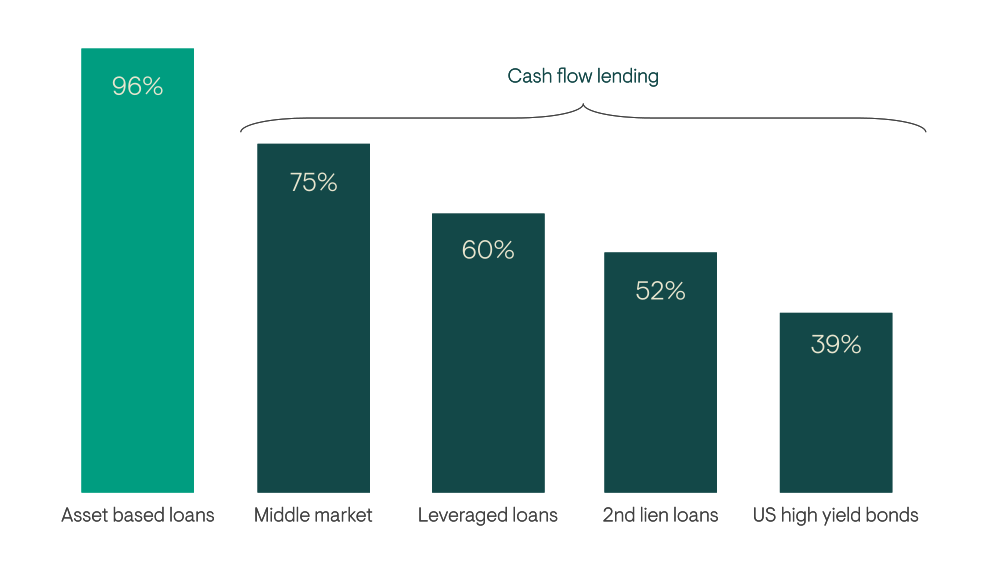
Source: Ninety One, Fitch Ratings Ultimate Recovery Rate Study 1987 - 2019, Moody’s data.
3. Private equity-style underwriting
Successful execution in the non-sponsored private credit market requires private equity-style underwriting, and workout capabilities are essential as there is no sponsor to step in during times of stress. These challenges – alongside the fact that sourcing channels are off the beaten track – deter many traditional lenders. In other words, the barriers to entry in non-sponsored private credit are high. This creates an attractive opportunity for those with the right expertise and platform; strong structural protections and limited competition can result in unlevered gross returns in the mid- to high- teens.
In summary, asset-based loans to non-sponsored borrowers are designed with downside risk management in mind. The combination of strong collateral, borrower alignment and lender control can create a robust risk profile. In uncertain or deteriorating market conditions, this form of lending can be particularly well placed to defend capital while continuing to generate contractual income.
Why this matters now
European credit markets are diverging. Sponsor-backed lending is mature, commoditised and highly competitive. Meanwhile, non-sponsored mid-market borrowers remain starved of flexible capital, despite representing the backbone of the continent’s corporate landscape. Private credit managers with specialist capabilities are stepping into this void, offering tailored solutions where banks cannot.
Given the favourable competitive dynamics of the non-sponsored market and the general willingness of target borrowers to pay a premium for a solution that is not available from banks and other traditional lenders, private credit managers can target attractive rates of return on loans with extensive security packages and collateral built into loan terms.
For investors, this creates an opportunity to access a relatively untapped, high-quality segment of the market. The appeal lies not only in the potential for compelling returns, but in the diversification and downside protection these investments can bring to a broader credit allocation.
Conclusion
Bank retrenchment in Europe continues to gather pace. With emerging signs of NPL ratios rising, banks’ appetite for risk is likely to continue to fall. As banks step back from lending to SMEs, the need for alternative sources of capital continues to grow. For specialist private credit managers, particularly those offering secured, asset-based loans to non-sponsored borrowers, the opportunity set is significant. For investors, this is a structural opportunity that can offer meaningful value across cycles.
General risks: The value of investments, and any income generated from them, can fall as well as rise. Past performance is not a reliable indicator of future results. Investment objectives and performance targets are subject to change and may not necessarily be achieved, losses may be made.
Investing in debt entails risks related to a borrower's ability and willingness to repay the principal and pay interest. A rise in interest rates or a period of economic downturn could severely disrupt the market for private credit and erode a borrower's creditworthiness; should the borrower's financial situation deteriorate, the value of the security may also suffer a similar decline. Further risks include, but are not limited to economic, political and legal risks, currency risk, auditing standards and financial reporting differences, possible lack of diversification, control issues, market fluctuations and interest rate risk.
1. Source: Scope Group, Scope Ratings EU Banks: NPL Heatmaps Q4 2024.
2. European Central Bank, June 2024.
3. Source: ECB Euro area bank lending survey Q1 2025 and Q4 2024.
