Transition report 2025
Welcome
Decarbonisation is fertile ground for commercial capital.
Welcome to our inaugural annual transition report for the Emerging Markets Transition Debt strategy. We launched the strategy to address a fundamental gap in global climate finance through commercially compelling investments.
Reflecting on the strategy’s first full year of investing, the backdrop has shifted dramatically. While developed markets are moving more slowly on the energy transition, emerging markets are surprising dramatically to the upside. Crucially, this progress is being driven by economics rather than policy. Clean technologies have become the cheapest options for emerging markets’ economic and sustainable development.
For investors, this matters. Improved economics have expanded the commercial opportunity set in emerging markets. We see potential in renewable generation, energy storage, transmission infrastructure and distributed power. We also see it in the digital and operating infrastructure that supports these systems.
Another area of investment focus relates to the rising electricity demand from data centres – we favour companies that source their power sustainably and use it efficiently. Meanwhile, in transportation we have financed two of the largest producers of electric vehicle batteries. We have also financed a large renewable generator that is expanding into green molecules. These technologies aim to provide more efficient long-duration storage solutions for heavy industry and long-haul transportation.
On behalf of the portfolio management team, we look forward to another year of demonstrating decarbonisation to be fertile ground for commercial capital and updating investors on the growing pipeline of private-market deals in the portfolio.

1 Wider portfolio management team: Victoria Harling, Alan Siow, Nathaniel Micklem, Olivia Carballo, Martijn Proos.
Transition dashboard
Report highlights
Below you can see various snapshots of the portfolio through a transition lens and a country case study that uses current investments to illustrate the breadth of the investment opportunity set. For definitions of all the key terms and metrics covered in this report, please see here.
Projected gross cumulative carbon mitigated to 2030
Carbon
reduced
473m
tCO₂e
Carbon
avoided
344m
tCO₂e
Proportion of portfolio (ex-cash)2
Sustainable investments3
Carbon reduced investments with approved or committed to science-based targets
Green or sustainability-linked investments
Portfolio (ex-cash) breakdown by carbon mitigation
Financed emissions4
163k
Scope 1 and 2
753k
Scope 3
Portfolio (ex-cash) breakdown by transition classification
Breakdown of gross cumulative carbon mitigated to 2030 by transition classification (tCO2e)
| Carbon reduced | Carbon avoided | ||
|---|---|---|---|
| Committed to transition | 429m | 0m | |
| Transition enabler | 44m | 192m | |
| Transitioning | 0m | 151m | |
| Total | 473m | 344m |
2 As at 30 June 2025, cash = 15.3% of portfolio.
3 As defined under Article 2(17) of EU SFDR. The EMTD operates in line with Article 8 with a 51% minimum proportion of Sustainable Investments. Totals may not sum exactly due to rounding.
4 Emissions that are attributable to the capital provided to companies and assets via the portfolio’s investments.
Case study: Brazil
Decarbonising Brazil's energy value chain; from extraction to consumption
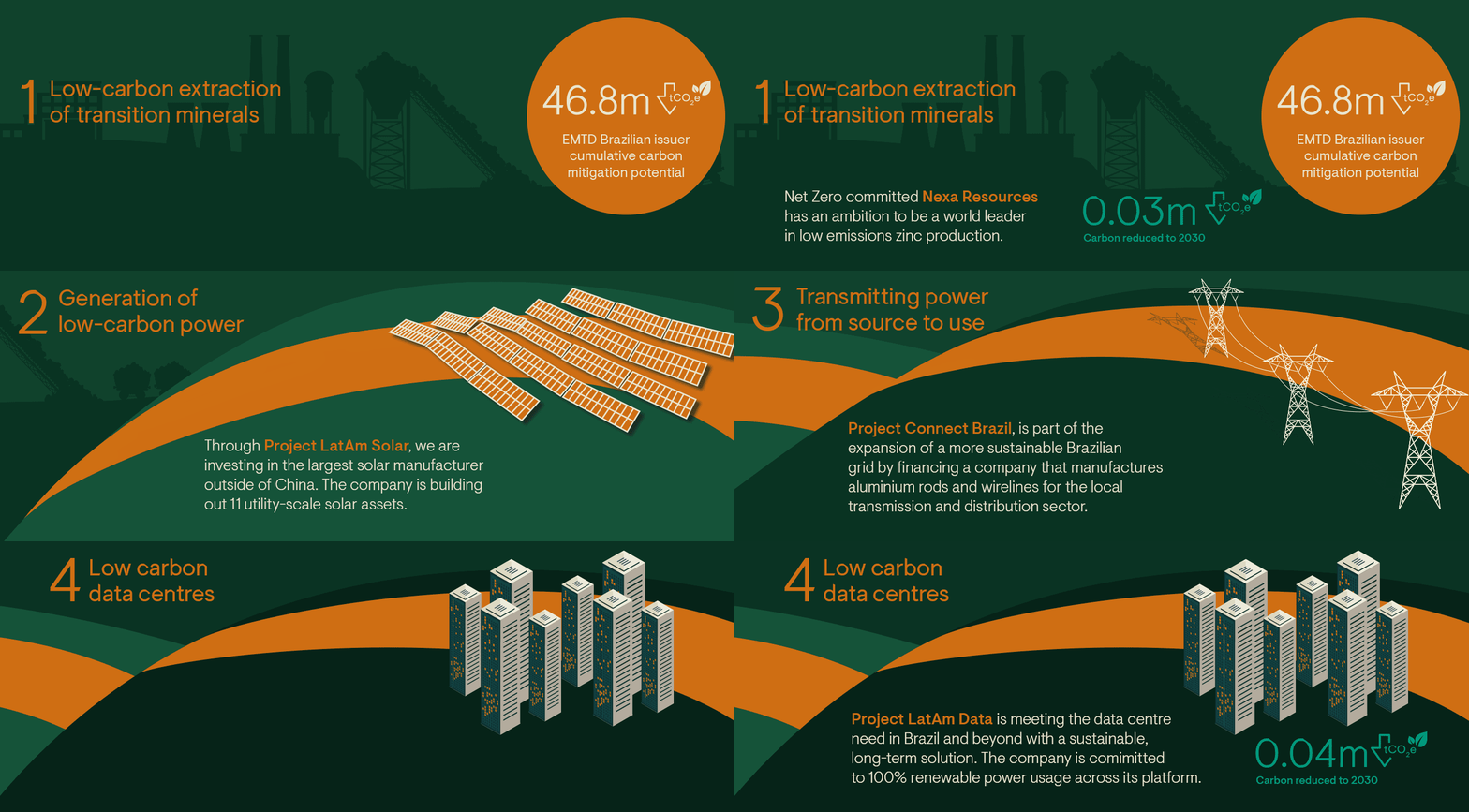
1. Low-carbon extraction of transition mineralsNet Zero committed Nexa Resources has an ambition to be a world leader in low emissions zinc production. 0.03m
|
2. Generation of low-carbon powerThrough Project LatAm Solar, we are investing in the largest solar manufacturer outside of China. The company is building out 11 utility-scale solar assets. 2.0m
|
3. Transmitting power from source to useProject Connect Brazil is part of the expansion of a more sustainable Brazilian grid by financing a company that manufactures aluminium rods and wirelines for the local transmission and distribution sector. 17.3m
|
4. Low carbon data centresProject LatAm Data is meeting the data centre need in Brazil and beyond with a sustainable, long-term solution. The company is committed to 100% renewable power usage across its platform. 0.04m
|

This is not a buy, sell or hold recommendation for any particular security.