Key takeaways
- Risks that have been building since the Global Financial Crisis are coming to a head, weighing on the US private credit market and extending to public credit markets.
- Broad market moves mask a diverse underlying credit risk picture. In developed markets, private credit carries significantly higher risk than public markets, and within public credit markets there is significant diversity in exposure to key risks now playing out in private markets.
- Public credit market investors must be selective but can take advantage of attractive valuations to build resilience in portfolios and capture growth opportunities.
Private credit thrust into the public eye
A confluence of events propelled private markets into the spotlight last year, with one headline after another revealing failures in the US private credit market, where crowding and a general weakening of credit standards have driven up risk.
Events this year are doing little to help restore investor trust in the asset class. In February, fears that the development and adoption of large language models (LLMs) could make business models obsolete drove a sell-off in parts of the equity market, with software as a service (SaaS) and business services sectors seen as most vulnerable to AI disruption. Private credit was caught in the crosshairs, as these are precisely the sectors that private lenders have invested heavily in. All of this has led to the stark realisation by retail investors – relatively new entrants to the asset class – that private credit and semi-liquid funds make for a fragile union, with some firms now struggling to meet rising redemption requests.
The path to today’s testing times for the US private credit market traces back to the Global Financial Crisis (GFC). A tightening of regulation caused banks to retreat from lending to riskier borrowers. Private-market firms stepped in to fill the gap, taking advantage of the era of ultra-loose monetary policy that made borrowing extremely cheap, while benefitting from limited regulatory oversight of the burgeoning and inherently opaque ‘shadow banking’ sector. Crucially, private credit has been the key financing channel for leveraged buyouts of software and IT companies by private equity firms; with many private loans now under pressure from higher rates and AI disruption risk, the chickens are coming home to roost.
Rethinking risk in developed private markets
In recent years, many asset allocators have increased their exposure to developed market private credit to capture the attractive advertised yields that compensate for sacrificing liquidity. However, the additional credit risk the asset class entails has been underestimated or misunderstood by many1.
Today, the quality profile of developed market private credit borrowers is significantly weaker than public credit. Simply put: private borrowers are typically smaller businesses with relatively high leverage and low interest cover. Private credit yields don’t simply reflect an illiquidity premium; the asset class has a risky credit profile, as highlighted in the figure below.
The credit metrics underlying private credit (US direct lending) imply a lower average credit rating than public markets
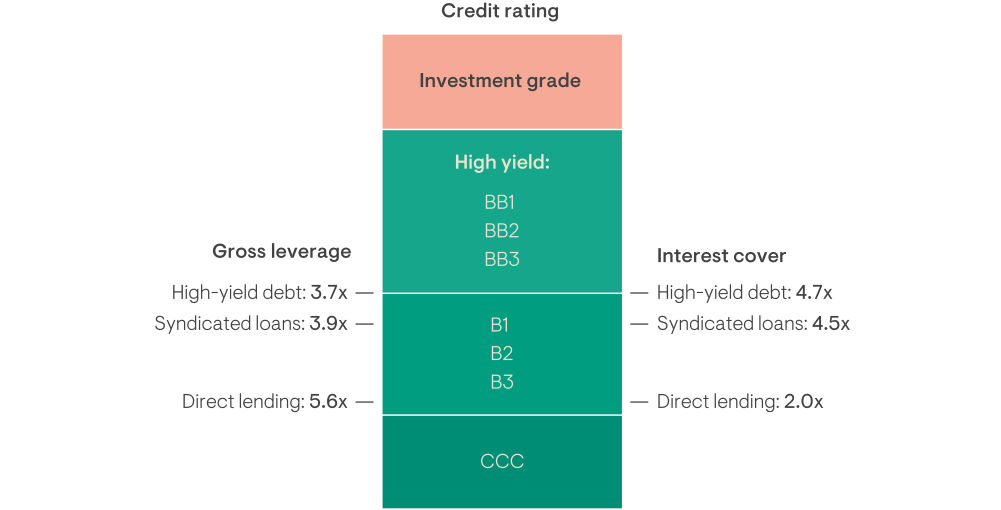
For illustrative purposes. Source: Ninety One adaptation adapted from Morgan Stanley’s Private Credit Tracker 4Q 2025 – As the Credit Cycle Turns. Morgan Stanley uses aggregate fundamental data on distinct portfolios monitored by rating agencies (Fitch, S&P, and KBRA) and valuation agents (Lincoln International); sources: Fitch, S&P, KBRA, Lincoln International VOG, Bloomberg, Factset, S&P Capital IQ, Morgan Stanley Research. Fundamental data as of 4Q25).
In addition, while public markets, especially in the US, tend to deal abruptly and decisively with problem borrowers and move on, it is a different story in the private space. The flexibility to amend, extend and PIK these problems into the future (PIK in this case means to turn off the cash coupon and instead pay borrowers in the form of new debt – rather than force a restructuring) eventually translates into distress that is abrupt rather than gradual and manageable. This could result in a potential spike in default rates at the point that these risks are realised.
Broader market moves paint a misleading picture
Negative sentiment relating to the AI disruption theme has spread beyond private markets, as reflected in spread widening seen across the public credit market in recent weeks. However, this masks a more nuanced backdrop.
First, the overall risk level differs between the two asset classes. The growth and expansion of private credit outlined above has shifted the broader investment landscape: there has been a big increase in credit quality in the high-yield segment of the public credit market relative to previous cycles as private markets lenders have been playing a bigger role in deals at the riskier end of the spectrum.
The second nuance is that across the public credit market spectrum, there is significant diversity in exposure to AI disruption and other risks currently playing out in private markets. Certain areas – such as the leveraged loans market - face similar challenges to private credit given their exposure to the software sector. However, other segments, such as investment-grade and high-yield debt, have limited exposure to the sectors most vulnerable to AI disruption, and the indiscriminate sell-off in public credit markets does not appear to be representative of the potential downside risk from this theme.
How can investors in public credit markets navigate these new risks and opportunities?
Several areas of the public credit market stand out currently. First, investors can seek out safety in higher quality opportunities like insurance sector issuers. Insurers own a lot of private assets, but their balance sheets (solvency) are very robust and investors today can find A-rated debt with spreads comparable to BB rated bonds from companies with robust risk management and capital strength.
In a similar vein, a generous compensation for risk can be found among bonds issued by BDCs (BDCs are publicly traded private credit vehicles): these structures are resilient and able to stay current and pay back in scenarios that incorporate default rates much worse than 2008. With spreads for investment-grade rated BDC structures comparable to low BB or high B rated corporate debt, investors are well rewarded.
In both cases, investors should focus on owning senior, well collateralised bonds and take a highly selective approach.
Related to the AI theme, caution is warranted in US investment-grade debt as the supply from the hyperscalers is changing the technical dynamics in this market, as we noted here. Turning to the high-yield market, high levels of dispersion are creating compelling alpha-capture potential for bottom-up investors, as we noted here.
In summary
Overall, the credit landscape is shifting as risks that built up during years of easy money begin to surface, particularly in developed market private credit, where leverage is higher and problems can be delayed.
While this creates uncertainty, it also presents opportunities for disciplined investors who focus on credit quality and selectivity. By avoiding the most vulnerable sectors and targeting well-structured, higher-quality assets, bottom-up investors can navigate these risks while taking advantage of attractive valuations to capture return opportunities.
General risks. The value of investments, and any income generated from them, can fall as well as rise. Where charges are taken from capital, this may constrain future growth. Past performance is not a reliable indicator of future results. If any currency differs from the investor’s home currency, returns may increase or decrease as a result of currency fluctuations.
Specific risks. Default: There is a risk that the issuers of fixed income investments (e.g. bonds) may not be able to meet interest payments nor repay the money they have borrowed. The worse the credit quality of the issuer, the greater the risk of default and therefore investment loss. Derivatives: The use of derivatives may increase overall risk by magnifying the effect of both gains and losses leading to large changes in value and potentially large financial loss. A counterparty to a derivative transaction may fail to meet its obligations which may also lead to a financial loss. Interest rate: The value of fixed income investments (e.g. bonds) tends to decrease when interest rates rise. Liquidity: There may be insufficient buyers or sellers of particular investments giving rise to delays in trading and being able to make settlements, and/or large fluctuations in value. This may lead to larger financial losses than might be anticipated.
Download PDF
1. It is important to note that the risk profile in private markets is very different in uncrowded emerging markets, where lenders can find high quality borrowers and stipulate robust security and protections in deals. Our focus here is the maturing developed market private credit asset class.
