Our EM Alternative Credit investment approach
- We focus on areas of the asset class that provide the best risk-reward profile: corporate credit and infrastructure debt.
- Our pan-EM networks create a distinctive deal-sourcing platform, spanning in-house sourcing, local banks, and brokers and development finance institutions.
- We favour strong borrowers (with defensive balance sheets and durable market positions) and markets where infrastructure assets benefit from significant sovereign support.
- Our approach combines attractive return potential with a focus on senior and senior secured lending.
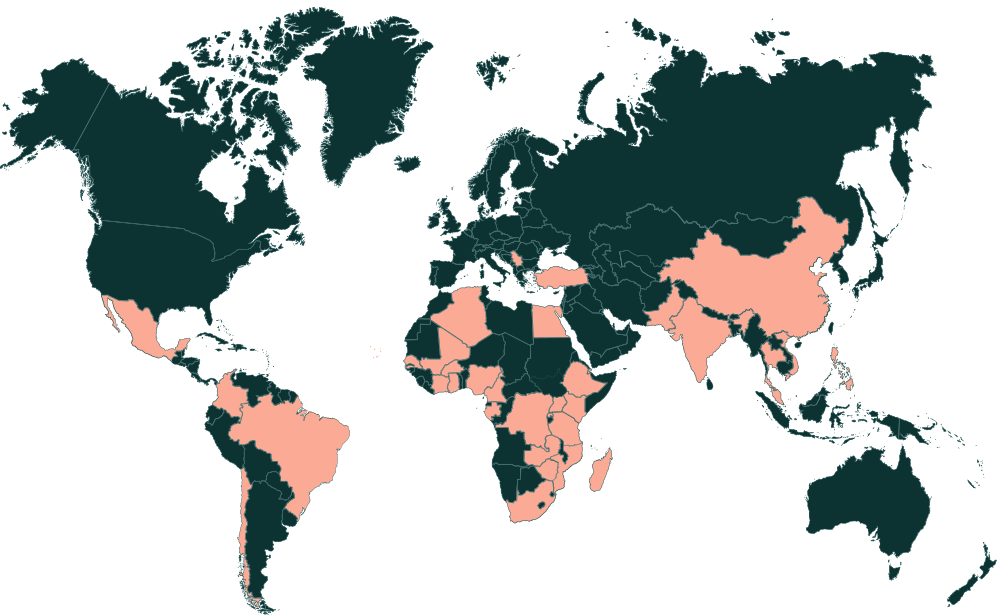
- Our portfolios are diversified across sectors, debt instruments and geographies – the map on the right shows countries in which deals have been signed in recent years.
Scale, performance and investment skills
|
Diversification and risk control
|
Customisation and sustainability
|
Source: Ninety One as at March 2026.
Private Market strategies focused on client solutions
| EM & Africa Credit Opportunities | Emerging Africa and Asia Infrastructure | Emerging Markets Transition Debt |
|---|---|---|
| Pioneering EM senior credit strategy | A-rated* blended finance debt fund supporting impactful infrastructure development | Seeking commercial returns while promoting real-world transition |
| Focus on SDGs; funding solutions to social and environmental challenges | Deep sustainability and impact assessments performed on each project | Carbon reduction / avoidance measured to 2030 and tracked annually |
| 7.5-year term | Permanent capital vehicle | Evergreen |
| 10-year track record | 20+ year track record | Launched 2024 |
| Over US$1.5 billion in AUM in hard currency strategies | ||
| 40 - 60 Investments | ||
*A2 rating from Moody's
The value of investments, and any income generated from them, can fall as well as rise.
Emerging Markets Alternative Credit
Frequently asked questions (FAQs)
What is the team’s philosophy?
In untapped emerging markets (EM), experienced lenders can afford to be selective – commanding a pricing/return premium over developed market (DM) deals and stipulating robust collateral protections and strong covenants. That translates into generous compensation for a comparable level of risk to DM.
How have the platform’s investments behaved?
With annual loss rates of below 0.5% achieved on US dollar-denominated portfolios managed since 2014, Ninety One’s EM private market strategies align with an investment-grade profile.
How has the platform evolved?
Ninety One began building its private credit platform in South Africa during the global financial crisis. When international capital retreated and high-quality South African borrowers were left stranded, we stepped into that gap, underwriting senior loans at attractive valuations and laying the foundation for a high-yielding credit strategy named Credit Opportunities. From those beginnings came the African Credit Opportunities strategy for international investors looking to secure uncorrelated hard currency returns. This led to Ninety One being awarded the mandate to manage the Emerging Africa & Asia Infrastructure Fund (EAAIF – part of the Private Infrastructure Development Group), backed by a consortium of global development finance institutions, and more recently the SA Infrastructure Credit Fund and Emerging Markets Transition Debt Fund.
What type of investors do you cater for?
Our strategies accommodate a range of investor preferences. Some use blended portfolio-enhancement techniques, such as first-loss protection, to achieve investment-grade ratings and appeal to investors who want to avoid high risk-weighted assets; others adopt a public–private structure to enhance liquidity. Some strategies allow investors to align allocations explicitly with sustainability objectives such as decarbonising high-emitting sectors.
What does a typical deal look like?
Building on deep experience in closing deals in uncrowded African markets, Ninety One’s EM private credit investments feature many layers of protection, including low corporate leverage, lending to high-quality borrowers, and structuring deals to include robust covenants – with active loan monitoring conducted throughout the life of each loan by a dedicated team.
How is your origination platform different?
We have built up a proprietary network of more than 500 sourcing partners across emerging markets, which allows us to be highly selective in the opportunities we participate in. Our extensive reach allows us to uncover deal flow that rarely appears in syndicated or brokered markets. Unlike in the crowded and increasingly binary (sponsored/non-sponsored) developed market, we work with a combination of sponsors, local entities and governments – the common denominator is an attractive risk and return profile for each deal we participate in. Furthermore, while lenders in developed markets often compete with banks, Ninety One has a long track record of partnering with them. This is a structural growth area: on the one hand, banks’ need to de-risk balance sheets is creating a demand for syndication channels; while on the other, institutional investors need scale and diversification – Ninety One works with both to create diversified pools of assets.
How durable is your competitive edge?
The need for global EM expertise and the deep origination platform necessary for building diversified portfolios has deterred broader participation in the EM private credit market, creating a barrier to entry. With competition relatively limited, experienced investors like Ninety One have strong bargaining power; rather than having to compete on loan pricing and protections, they can stipulate lender-friendly deal terms – including robust protections – and focus on the most compelling opportunities. Given the time and effort to build up the necessary networks and expertise, we believe we have a durable competitive advantage.
Contact the EM Private Markets team
1 All vintages of South Africa and Africa Credit Opportunities since inception in 2008 and the Emerging Africa and Asia Infrastructure Fund since 2002. Ninety One has managed EAAIF since 2016. The capital deployed amount includes reinvested capital.
2 Across open and closed USD private credit strategies since May 2008, and Emerging Africa and Asia Infrastructure Fund since May 2016. Gross of fees. The IRR range shown reflects historical net IRRs achieved by different funds within the platform. These funds have materially different investment objectives, strategies, risk profiles, fee structures and inception dates. The range does not represent a composite, average or expected return for the platform, and individual fund outcomes have varied significantly
General risks. All investments carry the risk of capital loss. The value of investments, and any income generated from them, can fall as well as rise and will be affected by changes in interest rates, currency fluctuations, general market conditions and other political, social and economic developments, as well as by specific matters relating to the assets in which the investment strategy invests. If any currency differs from the investor’s home currency, returns may increase or decrease as a result of currency fluctuations. Past performance is not a reliable indicator of future results. Environmental, social or governance related risk events or factors, if they occur, could cause a negative impact on the value of investments.
Specific risks. Derivatives: The use of derivatives may increase overall risk by magnifying the effect of both gains and losses leading to large changes in value and potentially large financial loss. A counterparty to a derivative transaction may fail to meet its obligations which may also lead to a financial loss. Emerging markets: These markets carry a higher risk of financial loss than more developed markets as they may have less developed legal, political, economic or other systems. Credit Risk: Where the value of an investment depends on a party (which could be a company, government or other institution) fulfilling an obligation to pay, there exists a risk that the obligation will not be satisfied. This risk is greater the weaker the financial strength of the party. The Net Asset Value the portfolio could be affected by any actual or feared breach of the party’s obligations, while the income of the portfolio would be affected only by an actual failure to pay, which is known as a default. Default: There is a risk that the issuers of fixed income investments (e.g. bonds) may not be able to meet interest payments nor repay the money they have borrowed. The worse the credit quality of the issuer, the greater the risk of default and therefore investment loss. Liquidity: There may be insufficient buyers or sellers of particular investments giving rise to delays in trading and being able to make settlements, and/or large fluctuations in value. This may lead to larger financial losses than might be anticipated. Sustainable Strategies: Sustainable, impact or other sustainability-focused portfolios consider specific factors related to their strategies in assessing and selecting investments. As a result, they will exclude certain industries and companies that do not meet their criteria. This may result in their portfolios being substantially different from broader benchmarks or investment universes, which could in turn result in relative investment performance deviating significantly from the performance of the broader market.